
The Midlife Scam: Work Now, Live Later
The case for playing hooky based on the amount of healthy days left.
I try to create the greatest articles because you appreciate irreverent, psychologically sophisticated writing (you don’t need another article telling you the best predictor of happiness is happy relationships). If inclined, introduce Provoked to new readers:
3 referrals → 1 free premium month
5 referrals → 3 free months
10 referrals → 6 free months
I am writing this from a pool chair. Chlorine is drying into a white film on my forearms as Kim Thayil’s memoir (A Screaming Life: Into the Superunknown with Soundgarden and Beyond) is propped against my knees.
Thayil, Soundgarden guitarist (best riffs here), altered his guitar’s tuning from the factory setting. He needed the standard strings to loosen up enough to growl, so his guitar riffs could be thick enough to spread on challah.

I am 52 years old. It is Tuesday afternoon. What am I supposed to be doing instead? A shit ton. There are 30+ emails waiting for me. Several invites to give a keynote, collaborators waiting for feedback, and as hell on Earth probably two strangers requesting a “brief 30-minute conversation” so they can monetize curiosity workshops at a company that will never me a nickel.
I am in the decade that outwardly successful humans describe as harvest season.
You planted in your twenties. You watered through your thirties. You fertilized in your forties, presumably while sleeping 5-6 hours a night and eating almonds over a sink. Now the branches are bending with liquid assets, and only an idiot leaves the orchard to sit beside a municipal pool.
It’s such a tidy story.
Scott Galloway has made a persuasive case that economic security comes first and freedom after. “Balance is a myth,” he has said. “You can have it all. You just can’t have it all at once.”
His formula is to surrender much of your twenties, thirties, and forties to work then reclaim your life once you possess a stable financial base. To his credit, Galloway admits a substantial portion of his fortune is due to the luck of the Irish (unsure what us Polish characters get). His humane definition of wealth is when passive income exceeds what you spend. Not bad, unless you think about wealth in terms of time, energy, and money.
Grant Cardone preaches using the same religious verses. “Wake up! No one is going to save you,” he writes in The 10X Rule. He also said, “If you know what day it is, you’re not busy enough.”
Cardone intends to work indefinitely. He would regard my pool chair as drug paraphernalia for underachievers. Fine. He can have the treadmill and I hope somebody wipes it down after his sweaty, tired, fancy brand attired corpse slides off.
There is much missing from these stories of heroic output. A surprising number of productivity empires are supported by people who never appear in the book acknowledgements. Somebody handles the orthodontist. Somebody notices the toilet paper is nearly gone. Somebody absorbs the emotional shrapnel from the thirteen-year-old who got benched at volleyball practice and now hates the coach, the sport, and apparently the entire family (yes, this is autobiographical).
When this work is conducted by a spouse, an assistant, or several people on payroll, the day can look like an untouched slab of marble waiting to be sculpted into revenue. Every hour appears monetizable because someone else is doing the dirty deeds. Cue AC/DC.
I respect hard work. I have been getting up before sunrise for years (you can build time self-efficacy - LINK). I have answered email from airport gates and once while a dental hygienist briefly left briefly to get rid of a burrito.
Grinding is a legitimate skill. But do you want your kids to be learning this in….grade school? college? The trouble begins when you become proud of having someone else in control of your weekly schedule.
A yet to be considered cause of despair
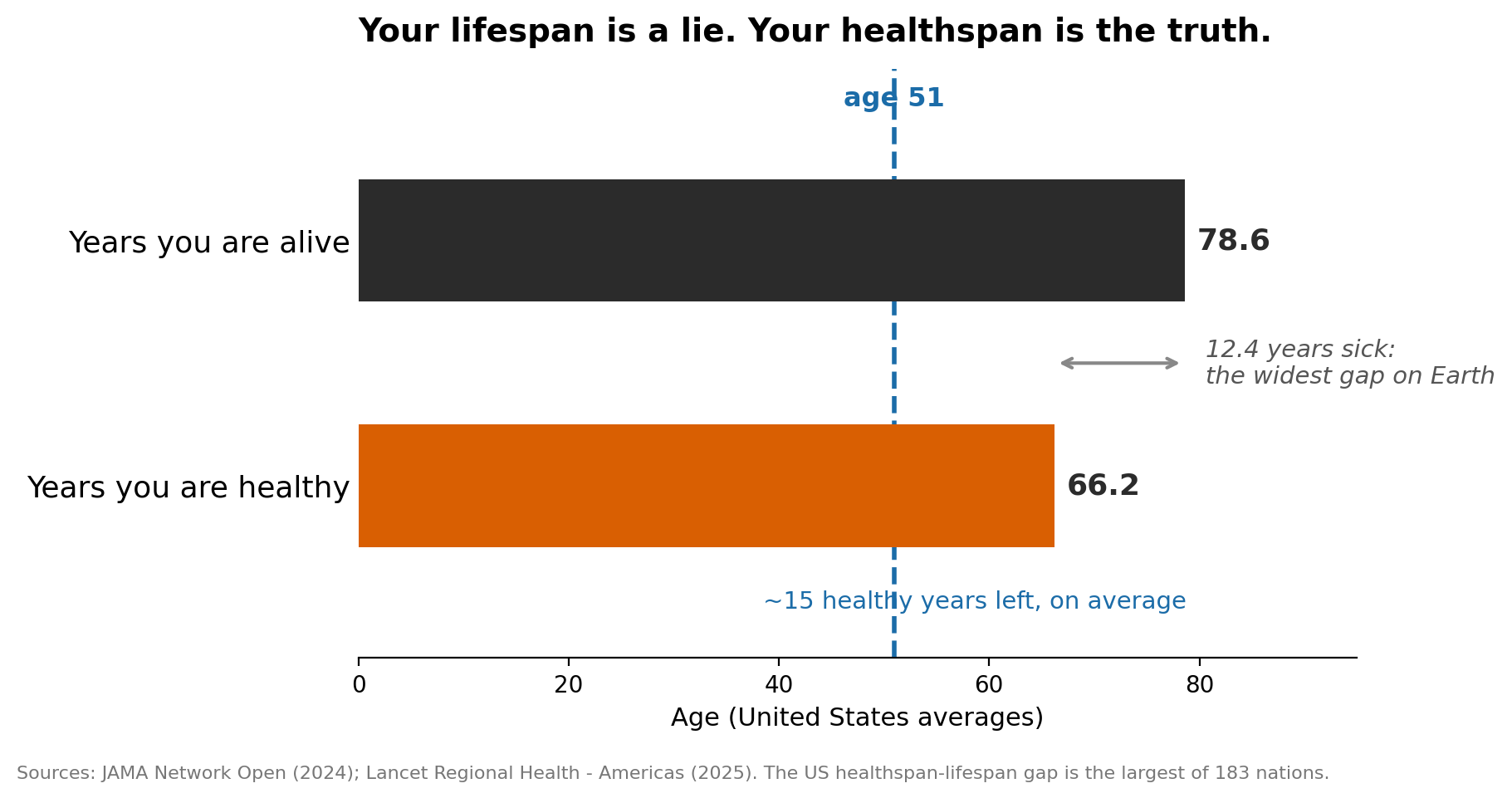
The United States has the largest gap between lifespan and healthspan among the 183 countries examined in a recent analysis. Americans live to 78.6 years on average. We spend roughly the final 12.4 years managing medical appointments to earn a color-coded binder (LINK).
Healthy life expectancy in the United States sits around 66.2 years. It declined despite the rise in total life expectancy over the past decade (LINK).
So let’s do some meaningful self-analysis.
I am 52.
Start with 78.6. Subtract 52. That leaves 26.6 years of average life.
Now remove the 12.4-year stretch when jumping down three stairs or playing 2-hours of pickleball leaves you wincing. I am left with roughly 14 years in which my knees, heart, balance, and frontal lobe have a reasonable chance of chilling together.
Some people will get 30 healthy years. Some will get four. A few will be doing pull-ups at 91 and will be deserving of one of those age-gap romances (resist the Netflix show Age of Attraction).
You do not know which hike is your last difficult one. You do not know which concert is the last one where you enjoy standing for three hours because its blissful.
The hustle formula asks you to accumulate resources for a future version of yourself who may have a digestive system that requires you to remain within visual range of a bathroom.
This is the problem with waiting to do what you love as you leverage those prime earning years. Earning years and able-bodied years are both fighting for your prioritization, every single day.
People who prioritize time over money report greater happiness than those who prioritize money, and the pattern exists regardless of income level (Hershfield, Mogilner, & Barnea, 2016). Spending money to remove an unpleasant task from your day produces more happiness than using the same money to buy another object (Whillans, Dunn et al., 2017).
Regrets about what people failed to do tend to outlive regrets about what they did, and the difference grows with time (Gilovich & Medvec, 1995). The embarrassing thing you attempted usually loses its teeth. The trip you kept postponing is what infiltrates your nightmares whether you remember them or not.
Our motives also change when we begin to feel the edge of the calendar. When people perceive more time ahead, they invest in information, expansion, and future possibilities. When time feels shorter, they become more selective. They choose emotionally meaningful experiences and people who matter now (Carstensen, Isaacowitz, & Charles, 1999).
Your brain is not becoming lazy. It has noticed something that is a source of meaning or even purpose.
Calculate Your Supply of Hooky Days
Look at the orange bar in the graph above.
Take 78.6.
Subtract your age.
Then subtract 12.4 years for the average American stretch of poor health at the end.
Your personal number might be much larger or cruelly smaller than the population. That uncertainty is precisely why you gotta do this.
My number is roughly 14.
That means I may have about 14 years left for hard hikes, red-eye flights, standing-room concerts, wrestling a suitcase into an overhead bin, and staying out past midnight without spending the next afternoon lying sideways on the sofa like a tranquilized zoo animal.
Write your number on a sticky note. Put it on the corner of the screen where you do most of your postponing. Before accepting an unnecessary meeting, look at it. Before volunteering for another committee whose final product will be a shared Google Doc that is mostly a waste of time, look at it. Before telling someone you love, let’s find a weekend later this fall, look at it.
The number will not tell you to quit your job and follow Phish through Delaware. It will remind you that nothing is being stored later for you.
You do not require a housekeeper named Consuela and a personal chef plating fennel. Buy back one hour.
Pay the teenager next door to mow the lawn. Order the groceries instead of wandering the cereal aisle under fluorescent lights. Take the toll road if it returns 35 minutes to your evening. Replace one professional lunch that to chow beside the person who makes you snort. Spend the reclaimed hour before work finds it and eats it.
People often save time and immediately refill it with smaller work. It’s what freakazoids are doing with AI. It saves them time and then they just do more crap with Ai to fill that time. And boom, they are a machine working for the man even more for…..for what? Your workload behaves like a gas. It expands until it reaches the walls of whatever room you give it.
Do not purchase an hour from the laundromat and donate it to Microsoft Outlook.
Use it while it is still warm.
Go somewhere your laptop is unable to function.
A caveat to everything above because the pool chair is not equally available
Everything I have written so far assumes you possess some control over your day. Millions of Americans do not.
For them, playing hooky is not a cheeky revolt. The United States welds health insurance to employment, which means stepping away from a job can mean stepping away from insulin or the next round of chemotherapy. COBRA may let a family keep its plan temporarily, but the monthly cost can approach $2,000.
Economists call it “job lock.” People remain in jobs they dislike because leaving could expose their family to medical catastrophe.
These trapped people do not need a lecture about boundaries. She needs healthcare. Wages create the same confinement. Someone working 40 hours who cannot cover rent and one broken car transmission has no spare hour to convert into a whimsical train ride.
Research on time affluence is different when you have neither time nor affluence.
Healthcare separated from employment and wages sufficient for an ordinary life are what allow for personal freedom. I don’t see this mentioned in all those self-help books on free will.
No one can 10X an uninsured gallbladder. Stop taunting the disadvantaged.
So take the hooky day when you can. Leave your phone in a bag for such a long period that several friends wonder whether you died.
Detune your life from the factory setting. The standard chord was selected by people with different appetites, opportunities, debts, and household staff.
Then use some of your money and political capital to widen the number of people who can occasionally disappear on a Tuesday without losing their health insurance or missing rent.
I am closing the laptop now.
My emails and tasks will still be there after I get in the water.
The more troubling possibility is that the water will not always be waiting for me.
Todd B. Kashdan is the author of several books including The Upside of Your Dark Side (Penguin) and The Art of Insubordination: How to Dissent and Defy Effectively (Avery/Penguin) and Professor of Psychology and Founder of The Well-Being Laboratory at George Mason University.
Read Past Issues Here Including:
Was Your Childhood Unsatisfactory? Answer Ten Questions and Find Out

Thank you for supporting irreverent, psychologically sharp well-being work. Every note you send and every new reader you introduce makes the weekly grind worth it. And I will reward you for recruiting fellow independent thinkers interested in helping humanity:
The FIRE stuff has always intrigued me for all the reasons you’re talking about! Life feels too short (and we all need access to more leisure time).
This article really hit home. I am blessed to have the freedom and flexibility to live a more leisurely life now that Ive retired from the military. A lot of people in my situation get another job right away and continue with the grind culture - but I just cant do that anymore. I want to live and love fully with the time I have left.