
In case you missed it…
Provoked is for playful, intelligent, creative, and discerning readers. If you enjoy this article, support the mission (be a free subscriber or get premium benefits).
I grew up in the age of Blockbuster. Fluorescent carpet, plastic clamshells, a wall where the new releases begged for your attention. At the age of 11, myy twin brother often searched the most violent movie in the store. The ones with the photocopied “18+” taped to the front like a dare. Our stepfather walked us past them with the same expression people use when they pass a house with a pet alligator. We rented anyway. Curiosity is a gateway drug.
Then we met the opening screen that shaped our ethics.
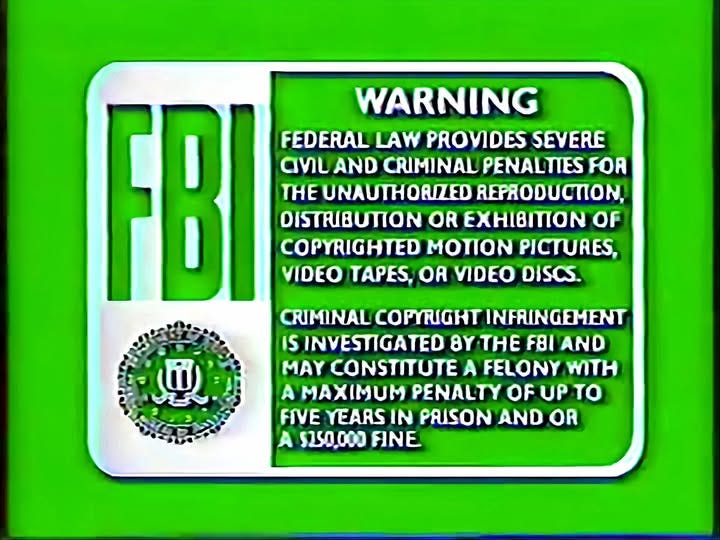
We looked at each other. We did the math. Prison sounded abstract, mainly because it was years before one of the greatest movies of all-time appeared:
Two hundred fifty thousand dollars sounded like all the money in the universe. Which meant demand. Which meant a market. So we did what every kid should have been doing: We borrowed the neighbor’s VCR. We learned to daisy-chain it with ours. We discovered the sweet spot where the tracking didn’t turn faces into scrambled eggs. We copied horror movies onto blank black tapes that smelled like a tire store. Then we sold them in grade school before the first bell. Five bucks a tape. Eight if it “had the good parts.”
There were production problems. Sometimes the copy included our mother yelling in the background to take out the trash (sounds I now miss dearly). Once the tape switched to a local news broadcast because someone sat on the remote. Elementary school customers still paid. There is no brand loyalty like a kid who thinks he is getting contraband.
We ran this empire for approximately three weeks. Then the principal called my mother. Someone told. The principal placed a plastic grocery bag on the desk and poured out our inventory like a DEA bust for ants. He read the FBI warning out loud. I tried to look remorseful. My brother tried to look like an intern. My mother looked at us as if she were meeting us for the first time.
No one went to prison. The neighbor asked for his VCR back. And the lesson landed late, like a bruise that shows up after practice. Not that crime doesn’t pay. That the dark traits we are busy diagnosing in exes and bosses already live in us. Just in Kids-R-Us sizes.
Foreshadowing
We keep calling exes and bosses narcissists, psychopaths, sociopaths. The words are overused to the point of mush. The Dark Tetrad are four dimmers, not scarlet letters. Narcissism. Machiavellianism. Psychopathy. Sadism. I am not zero on three of them. You probably aren’t either. That is not doom. That is design.
Admit it with me
On ordinary weeks, my admiration hunger flickers. A rival’s stumble sometimes tastes good, in a microdose. I do not celebrate them. I also do not deny them.
A little narcissism fuels visibility, voice, and persistence when feedback is weak (which is what most managers give).
A little psychopathy steadies hands in crisis and lets you cut a failing plan fast (a hidden origin story of grit - don’t miss this incredible overview).
A little sadism activates an impulse to punish cheaters. Harnessed, it defends norms without turning you into a bully.
None of these excuses harms. It reframes the internal qualities as energy that can be aimed.
Stop limiting the conversation to diagnoses
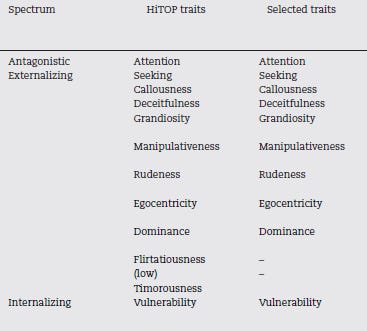
Narcissist, psychopath, sociopath are not everyday insults. They describe enduring patterns at the far end of distributions. Most people sit in the middle, spike under stress, then return to baseline.
Dimensional thinking beats category thinking because it asks how much, where, and when, instead of “what are you.”
Two short stories
Years ago a coauthor tried to edge me off a paper, even though I earned it with dozens of hard earned hours. My first impulse was Machiavellian. Hoard emails and perhaps leak a choice message to the department head. I drafted it. Then I slept. The next morning I called. We split authorship and shipped the paper. The energy that would have gone into chess went into the results. I trimmed the Mach within, and the work (and relationship) improved.
A scientific conference Q&A turned heated. A critic called my interpretation naive. The room turned to me like a courtroom gallery. The sadism dial itched. I had a perfect one-liner that would have landed hard and made the crowd blast out, “Ooooooooohhhh! Damn!” I swallowed it. I offered some data to refute the point. Later that evening, the critic bought me a scotch. The relationship grew far beyond the panel discussion. Humor withheld paid off in unexpected dividends.
Assess your own dark tetrad
Zero to 100 sliders. Answer for how mujch this characterizes you in a normal week and then a second time, when you are under pressure.
Narcissism sliders
I want applause after I give a great talk.
I fish for credit when I do great work.
I place myself at the center of stories that were not mine.
I feel wronged when peers get praise I craved.
Machiavellianism sliders
I share facts selectively to steer outcomes.
I trade favors with invisible strings.
I cultivate useful allies I do not respect.
I compliment as a door opener.
Psychopathy sliders
I cut safety corners for a rush.
I can harm and sleep well if I gained.
I stay cool while others panic, and I use that window.
I treat rules as speed bumps.
Sadism sliders
I enjoy a rival’s setback more than I admit.
I assign ugly tasks as payback (then call it something benign)
I post to inflame strangers.
I “teach lessons” with punishments that overshoot.
Convert each set to 1–5 by dividing the average by 20. That gives you four dials of darkness. Are you really telling me you scored nothing but a big, chunky zero?????
One more test of your dark side
Choose what you would actually do.
Found phone with banking app open.
Lock it and hand it in as is.
Peek at contacts, return it privately.
Send yourself a small transfer, then “recover” the phone.
First lowers Mach and psychopathy. Second is prosocial. Third loads psychopathy and Mach.
You own weekend schedules. A critic on your team just posted his availability.
Give them the worst slots and call it performance management.
Randomize and publish the method.
Offer one premium slot to model fairness.
First loads sadism and Mach. Second neutral. Third reduces narcissism and sadism.
Online argument with a stranger.
Write a brutal reply that earns likes.
Offer a clean correction with sources.
Close the tab.
First loads sadism. Second neutral. Third reduces psychopathy impulses.
Dilemma scoring. Dark option +1 to the linked trait. Neutral 0. Prosocial −1. Sum each trait across scenarios for a −4 to +4 adjustment, then divide by 4 to add or subtract up to 1.0 from the 1–5 dial.
Why “greater than zero” is not a sin
Low narcissism often is a sign of invisibility. A pinch of appetite helps you take the mic when the team needs a voice.
As for psychopathy? A pinch of fearlessness lets you cut a bad limb to save the body.
Low sadism can drift into conflict avoidance. A pinch of punitive energy, yoked to fairness, helps you enforce standards.
The key is leash length.
Even though the clinically significant problems of narcissistic personality disorder and their ilk are rather resistant to treatment, not so with these shadow syndromes I speak of.
There are things you can do to improve yourself or protect yourself.
Public credit transfer. Each week, hand the mic to a collaborator. List their specific contributions. This drains narcissism.
Transparent chess. Reveal one strategic thought you would normally hide. Revealing your thoughts prevents you from playing games with people’s lives and also will let others reciprocate: most humans have dark thoughts. This trims Mach.
Repair with cost. When you cause harm, fix it in a way that costs you time or status. Accepting personal cost is the medicine that resists the temptations of psychopathy.
Humor. Replace one roast with an inventive compliment that you know a person needs. If you feel bored by the positivity and obsequiousness and sanctimonious actions and humblebragging of others, notice the craving. That craving is sadism asking to be fed. Do not feed it.
Red team those dark impulses. Before handing out a petty punishment, ask a trusted peer, “Fair or undeserving?” Obey the verdict. This is what wise counsel is for…
Provocations
Whose failure would you secretly toast this month, and what does that expose about your values?
Where do you rename manipulation as strategy?
What spotlight do you chase as you pretend to be ego-free and a regular reader of Buddhist teachings on LinkedIn?
Four dials reflect the Dark Tetrad among hundreds. Honesty–humility, compassion, self-control, curiosity, openness, fairness. Grow these too. Your dark heat is a power source. Point it well or it burns the house you live in.
Know my Scientific Influences
Buckels, E. E., Jones, D. N., & Paulhus, D. L. (2013). Behavioral confirmation of everyday sadism. Psychological Science, 24(11), 2201–2209.
Jones, D. N., & Paulhus, D. L. (2014). Introducing the Short Dark Triad (SD3). Assessment, 21(1), 28–41.
Paulhus, D. L., & Williams, K. M. (2002). The Dark Triad of personality. Journal of Research in Personality, 36(6), 556–563.
Ashton, M. C., & Lee, K. (2007). Empirical, theoretical, and practical advantages of the HEXACO model. Personality and Social Psychology Review, 11(2), 150–166.
Miller, J. D., & Lynam, D. R. (2015). Psychopathy and the Five-Factor Model. Personality Disorders, 6(3), 303–314.
Patrick, C. J., Fowles, D. C., & Krueger, R. F. (2009). Triarchic conceptualization of psychopathy. Development and Psychopathology, 21(3), 913–938.
Final Thought
If you ever copied a movie and sold it to a child named Cody behind the bike rack, welcome. You are not a zero. The work is to keep your dials on a leash and aim them where they build something worth keeping.
For the Curious
If you love psychological science as much as me, I have a treat for you.
Don’t miss my FREE, LIVE conversation with the most eminent happiness researcher alive: Sonja Lyubomirsky
Wait until you hear about her new book!!
Put this on your calendar: November 17th at 430pm EST.
Here’s the link to join: https://open.substack.com/live-stream/77988
She is one of the smartest people I’ve ever met. I suspect you’ll feel the same after this hour.
Share this with someone who will enjoy it.
Comment - I will respond here and in the chat room and virtual calls.
Todd B. Kashdan is the author of several books including The Upside of Your Dark Side (Penguin) and The Art of Insubordination: How to Dissent and Defy Effectively (Avery/Penguin) and Professor of Psychology and Founder of The Well-Being Laboratory at George Mason University.
