
What Well-Being Interventions Actually Work?
A careful examination of what scientists say works in their publications and books.
In case you missed it…
Incredible relationship advice for online dating, romantic relationships, friendships, and parent-child interactions with the incredible Yael Schonbrun
Provoked is for playful, intelligent, creative, and discerning readers. If you enjoy this article, support the mission (be a free subscriber or get premium benefits).
What 27 Years of Teaching Well-Being Taught Me (Long Before It Was Cool)
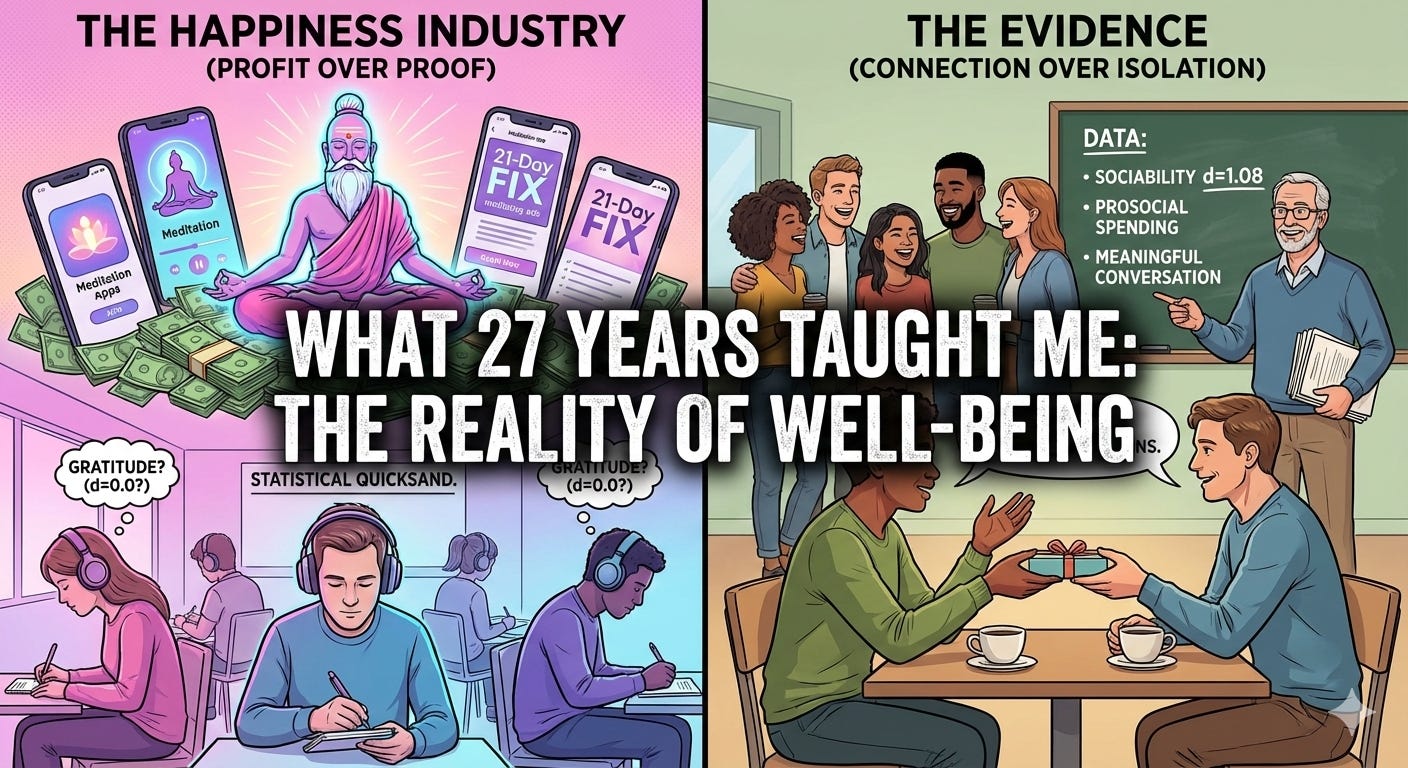
Tomorrow, Tuesday, February 3rd 2026, I will walk into my Psychology 417 classroom with a constantly revised stack of research papers I’ve been hauling around campus for over two decades. Different studies, sure. But the same fundamental question: What makes people happier?
Twenty-seven years. I’ve taught the Science of Well-Being to somewhere around 4,000 students. Watched the field explode from a niche academic curiosity into a multi-billion dollar industry of apps, retreats, and influencers promising transformation in 21 days. And here’s what happened to me as I spent this much time immersed in happiness research: I became increasingly skeptical. Which is a good thing. It means I prize precision.
A few weeks ago, I found myself at a dinner party doing something I normally avoid, which is talking about what I do for a living. The woman next to me, an executive at a tech company, lit up. “Oh! I’ve been doing gratitude journaling for three months now. It’s completely changed my life.”
I smiled and nodded. And I said nothing about the research sitting in my bag showing that gratitude interventions produce effect sizes so small they’re barely distinguishable from placebo, and even those modest effects fade within weeks.
Why didn’t I say anything? Because I’ve learned something teaching this course for 27 freaking years that people need to believe they’re doing something. The doing matters as much as the effect. Sometimes more.
But that doesn’t mean we should lie to them about what the evidence shows.
Teaching well-being research has made me worse at certain popular happiness practices. I can’t do a loving-kindness meditation without my brain calculating the null findings. I can’t hear someone recommend random acts of kindness without thinking about effect sizes that hover around zero when properly measured. I’ve become the guy who ruins self-help dinner conversations.
And yet, after being criticized for years for being a healthy skeptic among near-cult members, it has taken me two decades to fully appreciate that this same skepticism has made me better at the things that work.
Last semester, a student came to office hours crying. She’d been meditating every day for six months because her therapist recommended it, and she felt like a failure because she wasn’t experiencing the peace everyone promised. I showed her the highest quality studies, the ones designed before researchers knew what they would find, immune to the selective reporting that pollutes so much of this field and watched her cortisol levels drop (I think?).
“It’s not working because it doesn’t work for everyone,” I told her. “Not because you are doing anything wrong.”
She switched to something simpler, which was scheduling weekly in-person conversations with a friend she’s been meaning to see. Three months later, she told me it was the most significant change she made for her mental health all year. I made similar changes, something I will talk about another time…
That’s what 27 years of teaching this stuff has taught me. The flashy interventions that are money-making machines often have the weakest evidence. So we are going to talk about some novel strategies but also some seemingly boring stuff that has effect sizes two to three times larger than what gets marketed.
I’ve also learned something about myself. I’m a professor who studies purpose and curiosity, who wrote books about the topic (the newest one is coming soon with Michael Steger), and I still catch myself spending weeks on tasks that matter to no one. The research doesn’t immunize you from the patterns it describes. But it does make you faster at noticing when you’ve drifted.
Every semester, I update my verbiage and slides with new findings. Every semester, I wonder if I’m just rearranging gym equipment in the same room. But then a student tells me they changed how they spend their weekends, or stopped beating themselves up for not enjoying mindfulness, or started talking to people instead of texting. My internal chatter says something in the vein of Okay. This matters. Keep going.
What follows is this semester’s update on the evidence for what moves the needle on well-being, and what doesn’t.
🔒 The rest of this post is for paid subscribers
Below: the PowerPoint deck I’m using plus detailed breakdowns of the research findings that surprised.
