
I am an extrovert, and there is no memory of anyone labeling me otherwise. This is supposedly the ultimate historical moment for people like me. Open offices. A push toward real-world experiences such as haunted trails and pop-up bars in the back of gelato shops (just hit one in Toronto). Airplanes where another human is strapped 11.2 inches away from my shoulder for five hours. And my career requires an astonishing amount of time surrounded by a percentage of the 39,766 students at George Mason University. Plus I sit in meetings with babbalicious colleagues. I go to a crowded gym almost every day.
Apparently this is my paradise.
My girlfriend is an introvert, which has given me a highly trained field observer of moments when conversation is anathema and I am to shut down a tiny bit accordingly. I am getting better at understanding how two people can hold hands and stroll without speaking, an arrangement previously assumed to reflect someone’s fury.
I see it now. I even occasionally shut up.
But I want some acknowledgment for what happens in the other direction.
Put me on a subway. Across from me is a guy reading a book I love (let’s say, Middlesex by Jeffrey Eugenides). Three seats down, somebody is carrying a guitar case in a strange geometric formation. Two people are talking sufficiently loudly that I acquired 31.9% of a story and would very much like at least 27% missing.
I want to know what the instrument looks like. I want to know whether the guy likes the book. I want to know what happened to Denise. Instead, I look at my phone. I mean why not? Everyone else gets lost in their glowing rectangles.
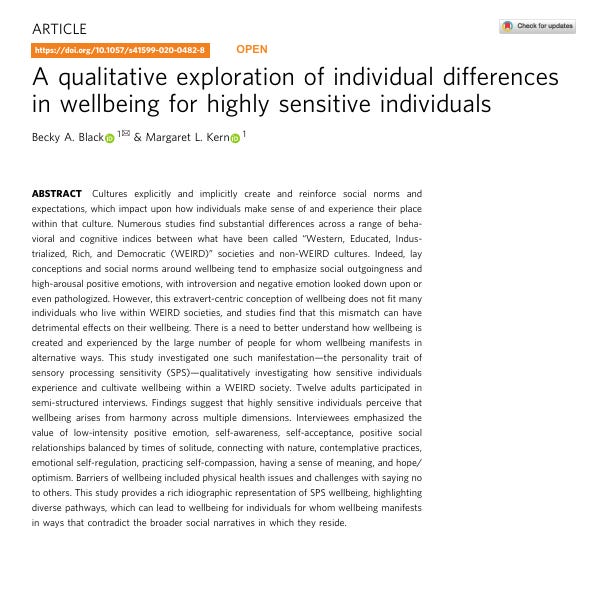
There is some lovely science suggesting my girlfriend is on the right side of history. Scientists interviewed highly sensitive people who were flying high in their lives despite the gregarious American ideal (LINK). They described close relationships, nature, contemplation, calm energy emotions, and deliberately limiting their daily allotment of stimulation.
Sounds wonderful. I don’t want to proselytize to highly sensitive folks in hopes they convert my way. Give them headphones. Give them offices with doors. Let them eat lunch alone.
What interests me is the person next to them. He sees someone reading a book he loves. He considers saying something. Then he thinks, She probably wants to read, and keeps his mouth shut. Meanwhile, she noticed the ridiculous psychology book sticking out of his bag five minutes earlier. She considered asking about it. Then she thought, He probably wants to be left alone, and returned to her book. Forty minutes later they get off at different stops. Maybe this is an ideal narrative arc where nobody bothered anybody.
There are other desirable outcomes in this supposedly extrovert-designed world. Maybe he tells her the ending of Middlesex annoyed him and she thinks he is an imbecile. Maybe they discover they both lived in unfinished basements in Detroit. Maybe she tells him something about her cousin’s intersex identity that blows his mind. Maybe they talk for seven minutes and never see each other again. (Ithink we undervalue that last possibility.)
There is a tendency to justify conversations with strangers by attaching some larger psychological consequence to them. Belonging. Friendship. Social support. Reduced loneliness. A stronger community. Apparently two people relishing each other for seven minutes is an insufficient return on investment.
I disagree.
Some of my favorite interactions have no sequel. I don’t know the person’s last name despite colliding with them for a bit. I’m not sure why psychology feels this must be upgraded into satisfying the basic human need to belong and then, finally, it can be deemed worthy.
I have trouble with the idea that the world is ideal for extroverts.
I am given enormous access to people while also facing a growing collection of rules governing social approach. Don’t interrupt someone wearing headphones. Don’t bother someone reading. Be careful approaching adults you don’t know, especially in the gym. Respect the person staring at a phone that functions as a sort-of, walled-off space.
Most of these guardrails exist for good reasons. I don’t want to repeal them. But guardrails change behavior even when people do not seek or want protection.
There is an odd asymmetry here. If I start talking and the person wants solitude, I have imposed a cost on them. If I keep to myself and they would have enjoyed talking, neither of us knows the loss incurred.
For extroverts like me, missed social opportunities cut a bit deeper, especially when reminded that society is extravert-centric.
The rules help us avoid bad social trespassing. I’m glad the rules exist. But perhaps we have become too good at teaching people how not to intrude than at creating graceful ways to indicate social advances are welcome.
Because right now I know how to tell you leave me alone.
I am much less sure how to tell you you can try me.
This asymmetry seems like a strange feature for an extrovert’s paradise.
Below, for premium subscribers, I offer strategies for improving stranger interactions.