
Psychological Richness: The Third Path to A Good Life We Crowned Too Fast
I will explain my skepticism with a monk, an adrenaline junkie, and a lot of thought experiments and questions.
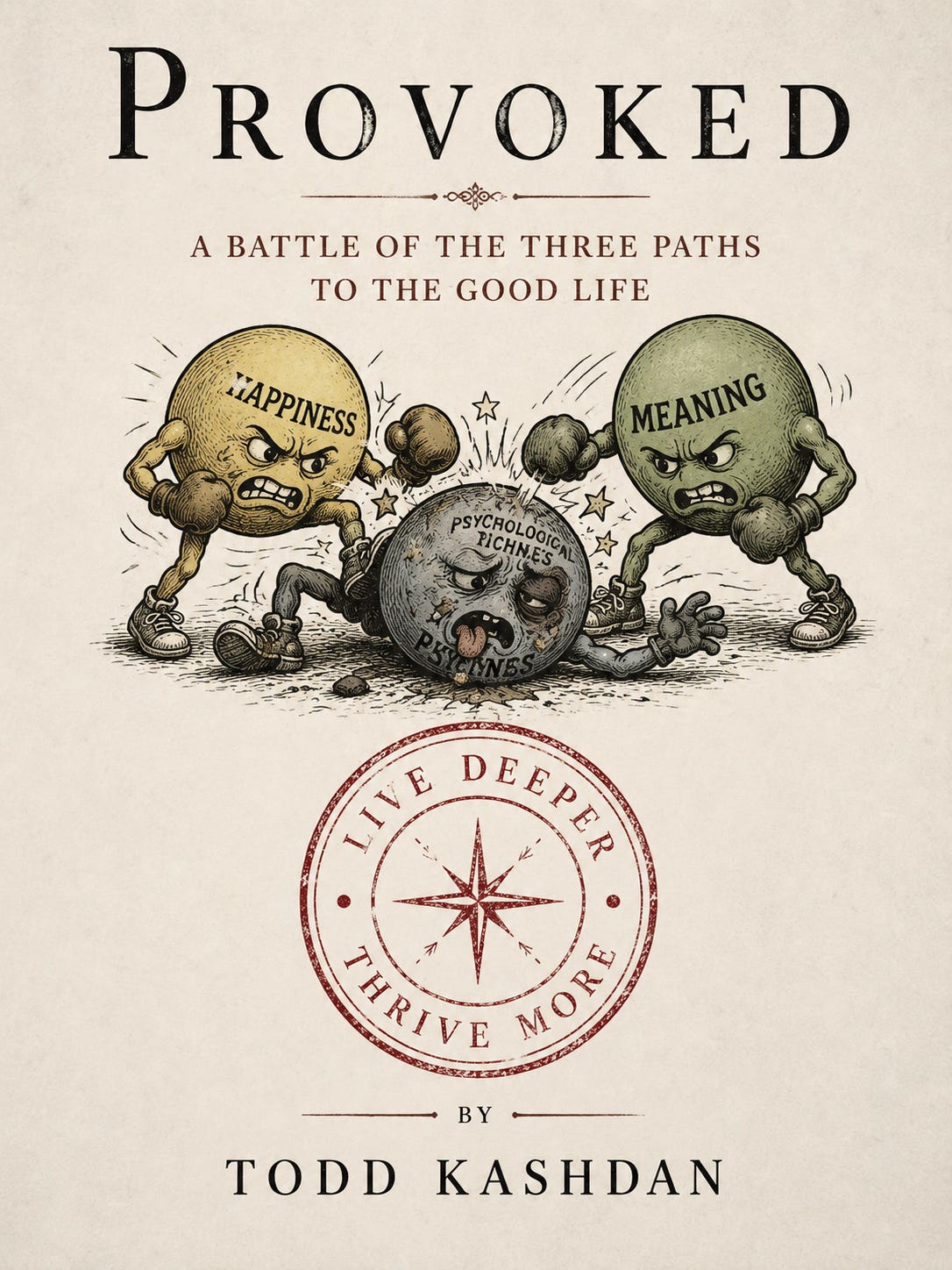
Three Paths to a Good Life???
There are two people at the end of their lives and each is at peace with how things went. One is a monk. He has spent decades in a stone room that smells of cold candle wax, waking at the same hour, sitting the same long stretches, feeling mostly one emotion which he would call contentment. The other is the friend everyone has, the one who has been bitten by something on three continents (looking at you RBD). She quits good jobs to learn glassblowing, falls in and out of operatic love, takes the night bus instead of the hotel, and collects perspective-shifting experiences akin to how my aunt Naomi collects crystalline animal sculptures.
Now answer fast. Whose life went better?
If you hesitated, you found the soft spot in one of the most talked about ideas in my field.
For most of its modern history, the science of well-being ran on two engines. There is the happy life, positive feelings and life satisfaction with only a small dose of negative emotions. And there is the meaningful/purposeful life, the sense that what you do matters and connects to something larger than your own timeline. Then Shigehiro Oishi and his collaborators proposed a third. They argued for it at length in Psychological Review and pressed the case again in Trends in Cognitive Sciences. They call it the psychologically rich life. The definition is tighter than it sounds: “a life characterised by a variety of interesting and perspective changing experiences.” Novelty that changes how you view the world.
It is a seductive idea and I am exactly the wrong person to trust about it because I have spent a career studying curiosity and I wanted it to be legit. A third path means the wanderers, the people who kept choosing the interesting over the safe thing were living a great life all along. I was ready to applaud.
Then a draft paper appeared (not by my research teams), not yet peer reviewed, with a reanalysis of the original data and went after the theory underneath it (read the paper - Link). It is the most useful kind of unwelcome. It does not claim psychological richness is fake/wrong/pseudoscience. It claims we crowned it before the supportive research sufficiently past the test of stability, replicability, transparency, and cannot be better explained by what already exists (but isn’t sexy because it’s older). It’s the speed that should bother us.
Start with the simplest question, the one a five-year-old would ask.
Is it good for you?
To count as a dimension of well-being, richness has to be something that makes a life go better. The critique points out that the case for it rests on a logical slide:
psychologically rich life advocates... move from saying, essentially, ‘some people say that they value psychological richness’ to ‘everyone would benefit from psychological richness’. These are two different claims. The first is purely subjectivist. The second is a universal prudential claim.
That is important. It’s a three card monte switch with very different meanings. The adventure junkie telling a researcher she values intense, perspective-changing experiences tells you what is good for her. It tells you nothing about the monk, who, after a great deal of reflection, wants the opposite and has built a life around peaceful existence with mother nature or other higher powers. One person’s adrenaline is another person’s idea of hell. And which of the three lives a person prizes links up with their politics, a 2020 study details (link), which is what you would expect from a value judgment rather than a universal ingredient of a good life.
We should not be defining the good life depending on whether you are espousing liberal or conservative values, or voting Democrat or Republican. Relatedly, this is why I argue against Openness to Experience in the Big Five as one facet is about endorsement of liberal values.
The second problem is that once the door is open, it is hard to alter or get rid of subpar ideas. If something becomes a dimension of well-being the moment people say it makes their life go well, the list runs forever. The critics put it without mercy:
Other candidates are the holy life advocated by Aquinas, the wise life advocated by Socrates, the virtuous life advocated by Aristotle... If the criterion for inclusion is just that people say something makes their life go well, then we can create an almost infinite list. ‘My soothing commute to work is good’ becomes a dimension of SWB.
I nodded at the commute line because it is correct. A concept that lets everything in explains nothing. That’s why I have a beef with people who say everyone is creative.
Then there is the valence problem to induce a few squirms. If a psychologically rich experience is good in and of itself, it should be good no matter how much it hurts, because the definition stays neutral about whether the experience feels good or bad. So a strange, violent storm in your neighborhood qualifies. So does debating trolls. So does this:
it should be good for people to experience starvation, a colonoscopy, a warzone, or the death of a loved one provided this results in new, interesting, perspective shifting experiences. Indeed, if these are the criteria for ‘richness’, then the more intense the negativity the better.
Try a fresher one. A man eats the wrong thing in Bali, spends two days hallucinating on a tile floor, and comes home a different person. Rich? By the letter of the definition, yes, and the more atrocious the illness the richer he gets. You can watch the idea drive off the road.
This is more than a thought experiment. A 2025 paper in Psychology & Marketing, running ten studies, found that people chasing psychological richness lean toward counterhedonic consumption, the academic phrase for choosing to suffer, because the suffering registers as self-growth. The concept is already steering real shoppers toward chosen pain, which makes the question of whether richness is good for them urgent rather than academic.
The critics reach for Dostoevsky as Dmitri’s realization in The Brothers Karamazov is that without God everything is permitted, is about as perspective-changing as a thought can be. Viktor Frankl built a whole therapy, logotherapy, whose intention is to hand a person their meaning back after a perspective shift shook it. Perspective change can wreck someone. Sometimes the cure is to undo the change. That suggests richness might be a road to well-being.
And do people even want it when nobody is prompting them? When Oishi’s team asked people to describe their ideal life words that surfaced included family, work, money, stability, peace. Richness mostly showed up after researchers handed participants a checklist that already contained it.
Force a choice between a happy life, a meaningful life, and a rich one, and most people pick happy first, meaningful second, rich a distant third. The preference for richness may be the kind of thing you reach for only once someone introduces it by opening their car trunk and then surprising you with items for purchase you never previously considered.
When the critics reran the original questionnaire, the items refused to showcase a clean factor for richness. Several independent methods pointed to four or five separate factors. Novelty items clustered together separately. Same for the boredom items. The single item about having “a lot of difficult experiences,” the one that should exist as a nucleus if hard, perspective-changing events embody richness barely connected to the remaining items (that said, this item is not part of the final 17-item questionnaire). A questionnaire built to measure one dimension behaves like four loosely related ideas. They also checked whether richness was simply a renaming of the personality trait of openness to experience. The two pulled apart, related but distinct, which is good news, but even that requires an asterisk because the statistical model that fit best also had the most noise.
I am not writing this to spoil an exciting theory and construct. I am writing it because we get drunk on new terms. A fresh construct with a stage-ready story glides through psychology like a rumor through a small town, and excitement does what excitement tends to do. It skips the boring step. The critics tie this to what some call the theory crisis. We keep building scales and running statistics before we have done the slow, unglamorous work of tough, rigorous tests of what we are measuring.
The critique is generous about what richness could become once someone thinks it through. Early in a life, when you have to try the wrong things to find the right ones, a person is psychologically rich out of sheer necessity. Post-traumatic growth, and even some psychedelic experiences, show that a shattering event can leave a person genuinely better off. There is something real here. It has just not been earned yet.
So if you have felt the pull of this idea, the permission to value your strange interesting detours, keep the feeling. A reader could finish that argument, look at her calendar of recurring meetings and say F it and book a solo trip to Lisbon to create a more self-congruous month. The trip might be wonderful. But if the only reason she went was to avoid being the monk in someone else’s framework, is it psychological richness pursuit? Do not let anyone convince you that a stable, single-emotion existence is a lesser one, or that you owe yourself a Hurricane Katrina experience for the variety. The answer to whose life went better, the monk’s or the adventurer’s, is that we do not know, and the people selling the third path do not know yet either.
I spent twenty years arguing that the pull toward the new and the strange makes a life bigger. I want psychological richness to be a further extension of this work and that of my predecessors and contemporaries.
Be curious about the idea. Be slower to crown it as fact.
How You Can Support the Newsletter
If you like Provoked, there are several ways to support me.
Subscribe! Even better, become a paid subscriber. If you are already a paid subscriber, scroll to the bottom for a way to grade yourself on richness.
Boost It: By sharing it and commenting here.
Todd B. Kashdan is the author of several books including The Upside of Your Dark Side (Penguin) and The Art of Insubordination: How to Dissent and Defy Effectively (Avery/Penguin) and Professor of Psychology and Founder of The Well-Being Laboratory at George Mason University.

Solid article, Todd. As slippery as the construct can be, this is why I keep coming back to the idea of a well-being equation. Rather than treating happiness, meaning, and psychological richness as rival versions of the good life, I see them as different parts of a good life, with each one playing a different role depending on the person in front of me. Psychological richness may be a useful way of describing what happens when curiosity leads a particular person into experiences that change how they understand the world and experience themselves. But that does not make it a universal prescription, and it does not mean, to your point, that we know yet whether it is truly separate from curiosity, temperament, or the older language of the good life.
So I would not throw out psychological richness. I would put it back inside a larger equation. The question is not whether a rich life is better than a happy or meaningful one, but when richness actually improves the quality of a particular person’s life and when it does not. For some, unfamiliar experiences may help them question assumptions they have been living inside for years. For others, it may become too much stimulation, or even a way of avoiding what they already need to face in themselves. That is why the good life cannot be reduced to one crowned path. It has to be worked out person by person.
But the scientific question is unavoidable: if every equation is different, what can we actually define and test? My answer would be that the categories have to be clear enough to study, while what they mean in a person’s life remains particular to that person. What changes is how they combine for a particular person at say a particular phase in their life. The equation varies and changes to some degree across time. That is also what your article pushes me to ask of my own framework: can it honor the person in front of me without becoming so loose that it can no longer be defined, measured, or tested?
Hi Todd, in the example with the monk and the adventurer would you say they both experience psychological richness? To me it seems that under all three models you could make a case for them fulfilling the criteria - they may both experience happiness, meaning and richness as they go further into their own experiences. The monk will go through awakenings and ascensions internally while the adventurer may have these same experiences externally.
I also wonder if curiosity necessarily leads to perspective shifts? I can imagine that reading many books can expand one’s perspective or add to one’s mental model of the world without causing a radical shifting in perspective.
On the other hand I can also imagine that someone who is persuaded to join an extremist group of who is swept up by a conspiracy theory or multiple conspiracy theories would report a radical perspective shift without necessarily being a curious person. What do you think?