
A man sits in a lab at Boston College, minutes from playing a violent video game and is handed a choice of whether to hear music that will calm him or make him furious. He picks fury and is not unusual. When Dr. Maya Tamir ran this the men who knew a confrontation was coming reliably chose the anger-inducing warm-up and then the angrier players beat the excited ones at the game (link).
That result on anger’s contextually specific value should have produced a big impact on well-being science. Instead, the field mostly ignored this work, continuing the long arc of studies, podcasts, social media posts, and self-help books as if feeling good was the primary thing worthy of consideration.
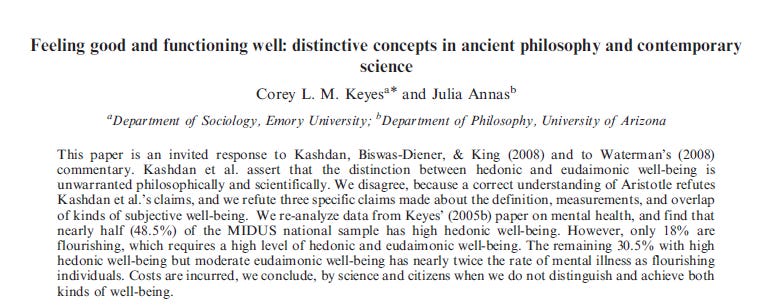
My friend Dr Matthew Iasiello, somewhere in a pub in Adelaide, has been arguing about who possesses the greatest decade long run of scientific brilliance in well-being science. It is a niche argument that sport enthusiasts have about who is the basketball GOAT (Jordan? LeBron? Stockton?) or ultimate movie director (Kubrick? Hitchcock?). Matthew picked Corey Keyes from 1995 to 2005 when he blasted out a cluster of papers with something like 50,000 citations that included his dual-continua model and concepts of languishing and flourishing (read his case HERE). It’s a strong pick as I have taught Corey’s work for over 22 years and he wrote a rebuttal to my target article (HERE) that was…..interesting.
In my view, Matthew chose a runner-up.
My pick is Dr. Maya Tamir, at the Hebrew University of Jerusalem roughly around 2007 to 2017. You may not have heard her name before and this is one of many embarrassing things about this thing called positive psychology.
Clearing the giants
But before we get to Tamir, let me push some of the obvious responses that other well-being scientists might throw out. Obviously, the kingpin is Ed Diener who built the runway everyone else took off from by initiating this field. Do make sure to read my ode to him (and two other giants):

If Diener didn’t create a computational model to think about and measure subjective well-being as more pleasant feeling, less unpleasant feeling and a sense that your life is going well (HERE) then there is no edifice for Corey Keyes and Maya Tamir to build on. Then of course you have Barbara Fredrickson, who build on the edifice of Alice Isen (READ THIS GEM), by giving us broaden-and-build to understand the function of positive emotions to widen attention and stock the elements of constructive living for later (LINK). Then she bolted to quantify the critical amount of good feelings for every bad one - the ratio of 2.9013 built from fluid dynamics equations and packaged in an influential trade book and still carries a long tail in helping young scientists develop and test new predictions about their role in aging, sport, work, love, etc.
Tamir’s awesomeness in five papers
Let me argue for a few scientific articles that make the case for Tamir’s yet to be appreciated influence listed from the oldest onward.
1. Implicit theories of emotion (2007). Following students through their first year of university, Tamir showed that the ones who believed emotions were fixed, that you get feelings and cannot do much with them, adjusted worse across the year with greater depressive symptoms and weaker friendships than the ones who believed feelings were material that can be modified and used like a tool (Tamir, John, Srivastava and Gross, 2007).
2. Hedonic and instrumental motives in anger regulation (2008). This is the fury experiment from the opening of this article. Men expecting a fight chose to make themselves angrier waving off the pleasant option, and the angry players then outperformed. Anger helped them. The music served as a tool for them to harness their darker emotions and some part of them knew they had the skill and internal knowledge of the self to pull this off (Tamir, Mitchell and Gross, 2008).
3. Sad as a matter of choice? (2015). Across three experiments, clinically depressed participants given the choice picked sad photographs over the cheerful ones and the mournful music over the upbeat, and when taught to reframe an upsetting scene they used the technique to twist it sadder. This raises all sorts of interesting questions about what does depression make us do? Or what do we do that (accidentally) maintains depression and self-sabotages? And how does this kind of approach to decision-making play a role in the dysfunction at work, in relationships, and in childcare for adults with depression? (Millgram, Joormann, Huppert and Tamir, 2015).
4. Why do people regulate their emotions? A taxonomy of motives (2016). This is an integrative paper that reorganized the field around a question of why people bother to regulate emotions. This has always been assumed and rarely tested. Her answer is that we chase useful feelings even when they make us feel like shit because sometimes guilt before an apology or anger before a fight is what is necessary to get the best possible outcome in the moment (Tamir, 2016). This work is what led my team to add a new dimension to the concept of psychological flexibility called harnessing (HERE).
5. The secret to happiness: Feeling good or feeling right? (2017). Across 2,324 people in eight countries, from Ghana and Poland to China and Singapore, the happiest were the ones feeling what they wanted to feel, even when the wanted experience was foul tasting (Tamir, Schwartz, Oishi and Kim, 2017). The power of this finding is illustrated in this image I created with AI:
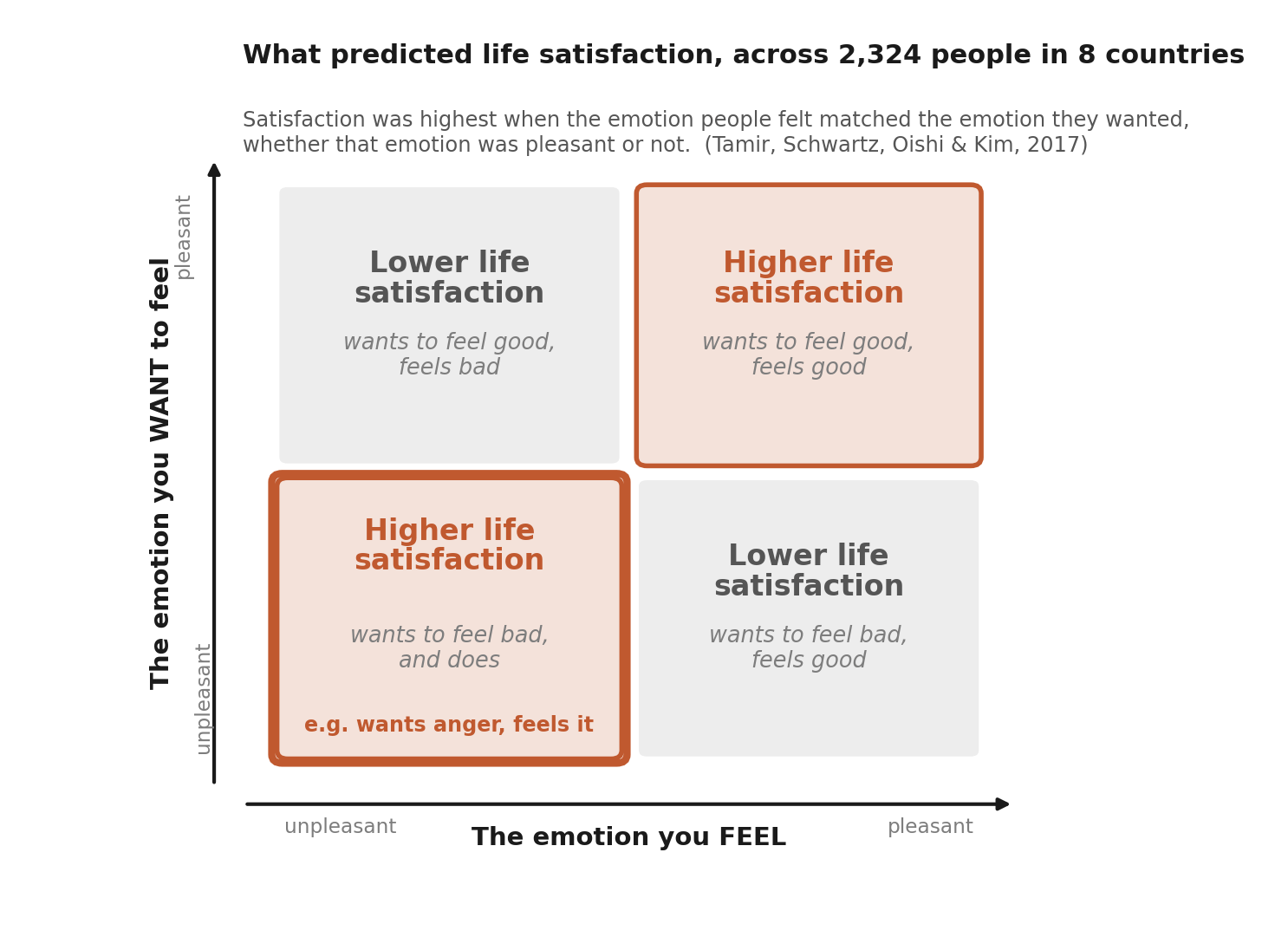
Half the argument of the book I wrote with Robert Biswas-Diener, The Upside of Your Dark Side (HERE) is derived from her work and those of her colleagues. Anger and guilt and boredom and anxiety and embarrassment and doubt and disgust and discontent are motivational fuel when treated as such. Check out Tamir’s data and you will find the vertebrae that served as essential knowledge for the spine of our argument. And more and more articles and books continue to hit the mainstream with the same argument that there is more to the good life than the positive…
Where did the citations go?
Now Matthew loves citations as the argument for esteemed scientist. Keyes has 50,000 citations for his decade. Tamir’s whole career, every paper she has been an author on, sits near 21,000 (Google Scholar). By these criteria, Matthew thinks he is right and there is no contest. But what I see is a travesty. Read the work and you will ask the same question as me as to why the hell are people writing about emotion generation and regulation and well-being and not citing her? I wonder why she has so few and I have plenty of potential explanatory attributions.
Because she is a woman? Affective science is full of women doing decade defining work, so a flat sexism story is not that compelling (but if I led with this culture war take more people would read and share this article). That said, I do want you to pay attention to the demographics of who gets crowned a founder of positive psychology, who gets paid the most to give keynotes, and who gets the space for the airport paperback. I got into a lot of trouble for mentioning that the first fellows of the International Positive Psychology Association, who were brought on stage and applauded for in a packed auditorium had something in common. They were all (white) men. The program coordinator who I mentioned this to was so pissed that I was never invited back to give a talk at their annual conference….ask them about it if you are a member. My hope is they are willing to say we were wrong, and looking back this is the benefit of having a group that welcomes and appreciates minority voices who dissent from the status quo - they liberate us from cognitive biases (LINK).
Because she works in Jerusalem instead of Cambridge or Urbana-Champaign? A scientist’s reach is still affected by their pedigree (one of the lamest things about academia is the elitism). An idea hatched inside the American positive psychology apparatus, with its summits and its millions of grant dollars from Templeton , flies first class in their private orb. An idea hatched in Israel and published in a strong journal still has the progenitor buying their own economy ticket where there are no signs of a warm chocolate chip cookie.
The likeliest reason is worse than either. Tamir never knelt down and prayed at the altar of positive psychology, a group that you kinda sorta had to join as a member. She did not feel the need to label her findings as part of the positive psychology movement, and she did not soften the complexity of her research for good marketing and publicity. She has been laser focused on high quality theory and evidence irrespective of how other people categorized her work. Social psychology? Affective science? Well-being science? Behavioral economics? These make sense. Positive psychology is a brand and some people don’t care about branding and if you do care, you miss out on so much exceptional work because it is off-brand. People chase the right feeling more than the good one, and a branded body of work built to maximize positivity skipped over this complexity.
What Keyes did
None of what I wrote about is meant to minimize the incredible work of Keyes. He earned every citation as he gave us a new form of consciousness in detailing this concept of languishing and he gave a generation terms for the grey blankness felt inside (Keyes, 2002). New terms that are useful in everyday life is a fantastic achievement. Tamir did something even rarer. She moved the coastline of how we study emotion. She showed us the territory of emotions that we had not even considered previously.
Use her work
You can leverage Tamir’s insights tomorrow. Before the next hardship or obstacle, the conversation about why you deserve a salary boost, the awkward conversation you have been avoiding with your kid about smartphone overuse, stop trying to get calm. Skip the box breathing and the gratitude list. Ask what the moment demands, and if you think it requires a cold burst of anger, let it rise, because you will handle the moment better carrying it than pretending a feeling of serenity that you do not possess. The unpleasant feeling is frequently what will lead to competence.
Matthew, you know I adore you, and Corey Keyes is a giant in psychology. But the best run our field has produced arose from a scientist in Jerusalem and we honor that by refusing to leave her off the marquee when those of us speak on human emotions and self-regulation. Give her work the long overdue attention. Maya Tamir.
Know someone who would enjoy this? Forward it. Want it to keep showing up? Subscribe, it’s free. And if my writing helps you think, become a premium subscriber and hand me a burst of joy and meaning.
Todd B. Kashdan is the author of several books including The Upside of Your Dark Side (Penguin) and The Art of Insubordination: How to Dissent and Defy Effectively (Avery/Penguin) and Professor of Psychology and Founder of The Well-Being Laboratory at George Mason University.

“That is, women show a more flexible psychological tool kit.
Hence: tend and befriend.” Yes. I read and reread your article, which was more like a book of knowledge. I appreciate you giving women credit where credit is due. Dr. Tamir’s work inspired me. It also expanded my idea about the concept of positive psychology. I jumped on the bandwagon way back when now I understand the upside of my dark side.
It also came to mind how long it took you to write this post, which once again blew my mind, actually opened it up. Many thanks. Can’t wait for the study with women.
Sorry Matt, I’m going with Tamir. I am currently holding a question for my own self awareness ‘in what ways am I denying my own experience’.