
This article is free because the topic matters too much to put behind a paywall. Please send it to people who might need it. If you value work like this, consider becoming a premium member (with loads of benefits).
“There is but one truly serious philosophical problem, and that is suicide,” Albert Camus wrote in 1942 (Camus, The Myth of Sisyphus).
Camus was asking whether life is worth living without a solid reason. Until a few months ago few could answer the practical version of when it might happen to someone.
This is not the first time I have felt pulled to write about suicide. I told the story of my own first suicidal thoughts once, and of three big risk factors that someone in a family might tragically die out of order.
Someone reviewed the last half-century of research and found that the standard risk factors predict who will attempt suicide at a rate barely better than flipping a coin (LINK).
I wanted to share the most impressive of suicidal studies “Using Smartphone Surveys to Predict Next-Week Suicide Attempts” in hopes it helps even one reader. More than 600 adults already at high risk kept a short survey on their phones for three months and answered it six times a day, close to 80,000 responses in all. An automated statistical model reading their answers picked out who would attempt suicide in the next seven days and did so more accurately than anything before.
The ability to predict what someone at high-risk will do next is worth the few minutes it takes to read this article. Here is my attempt to explain the findings in a way that does not require advanced statistical training.
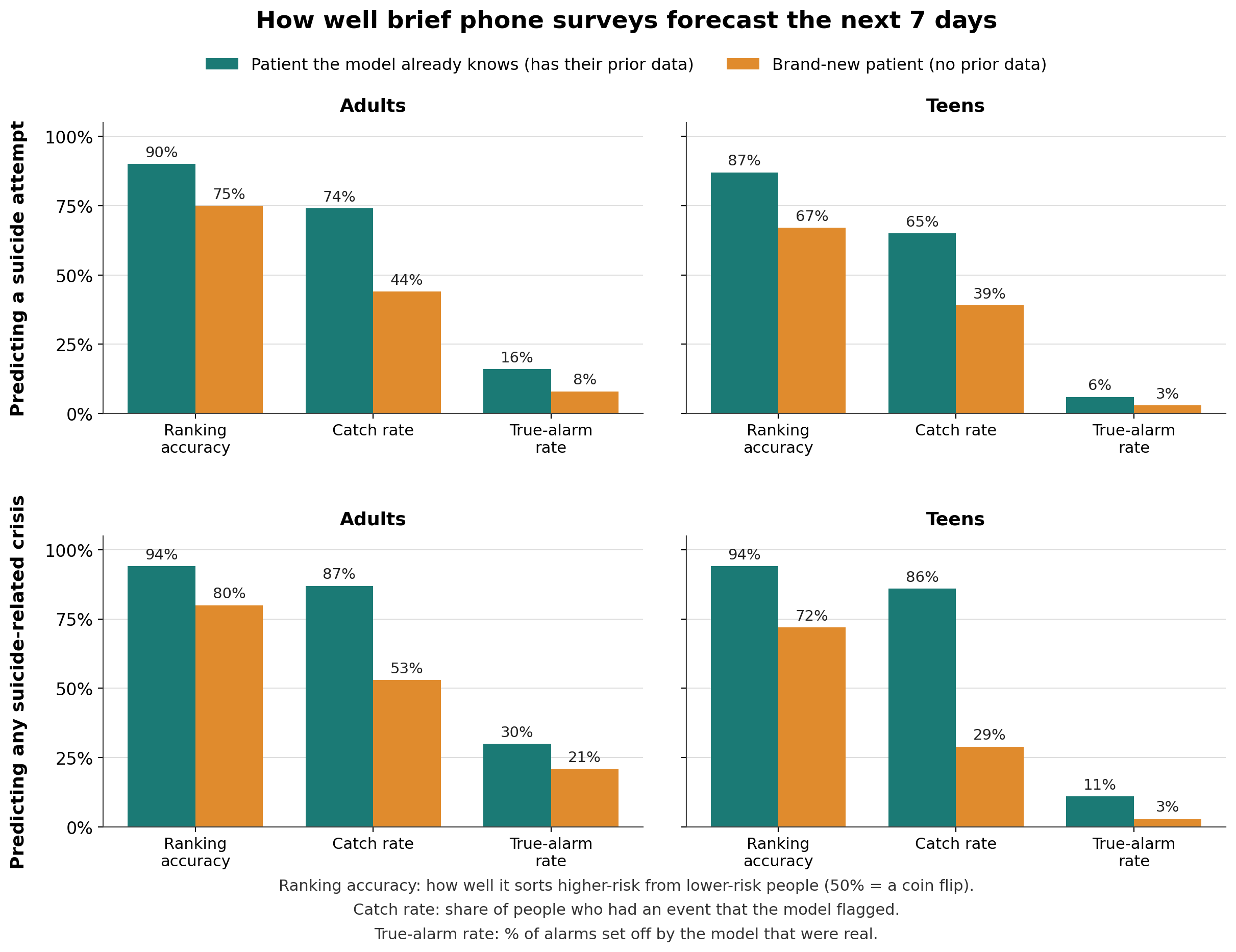
If the graph overwhelms you, let me describe it. When predicting any suicide-related crisis (this is a broader outcome that includes an attempt, an interrupted or aborted attempt, or a crisis hospital visit), the models are strong when the patient is known by the practitioner. For adults with prior data the model is able to catch 87% of those who go on to have an event. For predicting a suicide attempt specifically, which is rarer, the models are slightly weaker. Adults with a history are caught 74% of the time over a two week period. Now when a new patient arrives to a clinic and there is no background information on what they have felt, thought, or acted in the past, the model is even weaker with only a 44% catch rate. These data on suicide prevention raise interesting questions.
How can clinicians and hospitals get better at sharing information quickly? Like a data repository. Because if they do, fewer people die. But when sharing, how do they protect adults and teens so they are not treated like mental health nightmares? Because if someone with suicidal thoughts is worried they will be flagged as a threat, there is an above zero chance their information will be hacked and block access to jobs, housing, bank loans, and finding partners on dating apps. These real-world dilemmas need to be taken seriously and solved.
You might ask, why is the true-alarm rate so damn low? That’s because suicide-related crises and attempts are rare. By definition, a rare event is hard to predict. In the same way, meteorologists often mispredict hurricane strength and landings.
The ability to make accurate predictions is without a doubt, the headline. But I want to point your attention to small details that only feature as a blip in Figure 3 that are too easy to scroll past.
Adults who went on to attempt were rating their psychological experiences at the margins, regularly describing their worst feelings as a 10 out of 10 and pleasant experiences as a 0 over and over on the same day, with no signs of 3s, 4s, or 6s. This extreme responding was an extremely useful predictor. And the single emotion that predicted an attempt best was agitation, the restlessness that has you pacing the kitchen and pop in and out of bed during supposed sleep time. This restlessness was far more useful as a predictor than the more commonly discussed markers to look for, sadness and hopelessness.
You and I might envision the suicidal mind as slow and gray, sunk into a chair. The data point to a different image. Wired and restless, answering questions posed in absolutes. When a person ignores the middle of the scale, the small fixes stop working, because only big positives count for anything against a 10. Minds that lock into an extremity pattern tend to overinterpret bad outcomes with a sense of cognitive rigidity (LINK)
Use this knowledge to be better aware of yourself and loved ones. And do consider reading the full article:

For the next week, instead of perseverating on what constitutes your mood, focus on the magnitude. Notice days when a stubbed toe is a catastrophe and gorgeous experiences (compliments, accomplishments, exceptional soup dumplings, kisses) are dismissed, when experiences are viewed as only 10s (horrors) or 0s (emptiness). Document the event details. Teach yourself to notice the difference between short-lived, manageable misery and that which has been flattened into all-or-nothing. Do this so you can catch excessive thinking before it becomes dangerous.
We will resist romanticizing a single study that will never tell you why a person wants to die. That said, this study can help you better predict understand the importance of when someone’s dial dropped toward a mere two settings. Use this information wisely, please!
If you are there now, or sitting next to someone who is, help is free, confidential, and answered any time:
988 Suicide and Crisis Lifeline — call or text 988, or chat at 988lifeline.org.
Crisis Text Line — text HOME to 741741.
Veterans Crisis Line — dial 988 then press 1, or text 838255.
The Trevor Project, for LGBTQ young people — call 1-866-488-7386, or text START to 678-678.
Outside the United States — find a local line at findahelpline.com.
In immediate danger — call 911.
Know someone who would benefit from this? Forward it. Help someone who needs it.
Todd B. Kashdan is the author of several books including The Upside of Your Dark Side (Penguin) and The Art of Insubordination: How to Dissent and Defy Effectively (Avery/Penguin) and Professor of Psychology and Founder of The Well-Being Laboratory at George Mason University.
Read Past Issues Here Including:
FIRST LOOK - My Curiosity Productive Inefficiency Model

NOTE: this is part of a series on the science of curiosity including how this strength changes over the lifespan (click here for Part I and Part II), benefits memory and creativity (here), alters social interactions (here), persuades people (here), and
Such an important article. My lens about writing about suicide is; not to write because you can, but for all those that can’t!
Noting the agitation and pacing through the night has a visceral impact on my body for all the ordinary markers that seem too trivial to pay attention to.
So hard to predict and not what we typically envision. I worked in Thomas Joiner’s lab as an undergraduate and have followed his research on eye behavior. It’s super interesting if you want to take a peek.