
NOTE: this is part of a series on the science of curiosity including how this strength changes over the lifespan (click here for Part I and Part II), benefits memory and creativity (here), alters social interactions (here), persuades people (here), and can be boosted (here),
In my first year as a clinical psychology Ph.D. student, we were each asked to invent a measure on any construct. I chose curiosity and when I read the literature, I stumbled upon the paper that would make this topic a lifelong field of inquiry. To me, George Lowenstein’s (1994) paper on “The Psychology of Curiosity: A Review and Reinterpretation” remains the greatest scientific work on this topic.
Before Lowenstein got his hands on curiosity, for most of the 20th century, people could not decide on what curiosity was. There were drive theorists who believed it was an unpleasant itch that you explored in order to shut if off, the same way you eat salmon sashimi to ward off hunger. This served as an unsatisfactory model because it could not explain why anyone would voluntarily pursue a sense of wonder. After all, people will go to extraordinary lengths to see a new comedian or go on a new hike, or play pickleball against new competitors, which at the core serve as events with uncertain outcomes. The incongruity theorists (Piaget, Kagan, Hebb, and others) believed curiosity arose from violated expectations, from the world failing to match the model in your head. The competence theorists (such as the self-determination theory duo of Deci and Ryan) believed curiosity revolves around the pleasure of satisfying the need for competence in one’s environment, an appetite very sharp but also easily satisfied.
Curiosity is a weird creature because it can be superficial and intense at the same time. It is often a transient experience. It often results from an impulsive act. And it tends to be a letdown the instant it’s satisfied.
Nobody could explain how curiosity could exhibit all of these qualities. Until Lowenstein popped up. His reinterpretation was that curiosity is a form of cognitively induced deprivation that arises the instant you become aware of a gap between what you know and what you want to know. The gap exists as an equation with whatever you are attending to being compared to a reference point. And my reference point, because it is related to my experiences and notions about the world, will be different than your reference point. Discovering that some of the bubbles in your pint of Guinness beer sink instead of rise (study published in Nature - HERE), might bore you senseless despite causing me fascination.
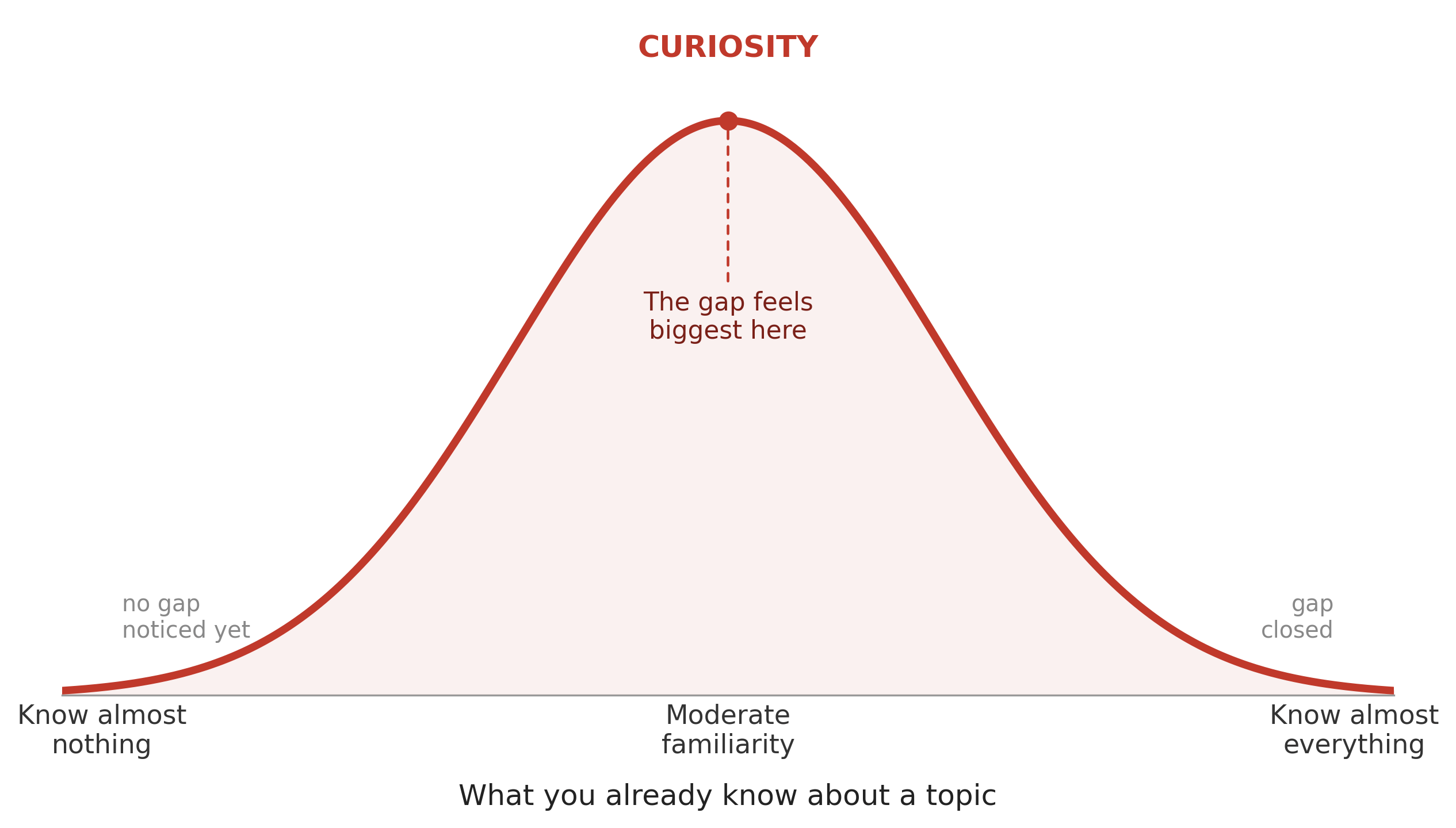
If curiosity comes from a gap, the more you know about a topic, the more finely you can perceive what you are still missing, which is why the world leading experts on beetles are more curious about an obscure species than you will be. Curiosity rises as you learn, peaks somewhere in the middle range of familiarity, and often disappears once the gap is truly closed. Here is my feeble attempt to capture the core principle of his model:
A few decades later, this led me to synthesize his work with other scientists to rectify the fact that this might be only one type of curiosity.
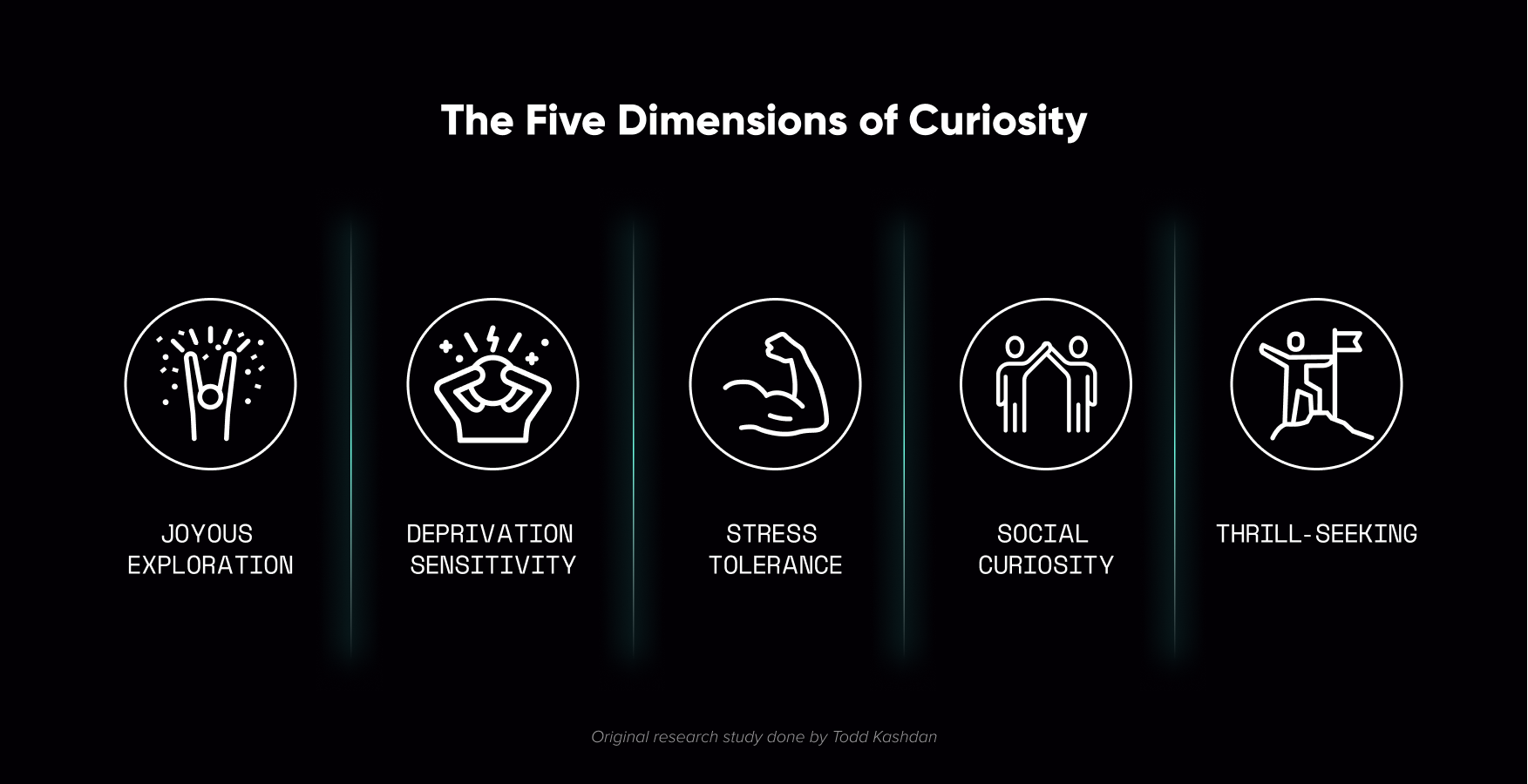
Since then, I have been busy working with colleagues on an extension of this model. Buried in Loewenstein’s account was a darker prediction that almost nobody followed. If one form of curiosity is deprivation, and it is the pain of the gap rather than the pleasure of the answer that is being pursued, then a person can be driven to close a gap fast in ways that have nothing to do with closing it well. The itch does not care whether the scratch is good for you.
That loose thread is where my newest work begins. Introducing our Productive Inefficiency Model of Curiosity.
I have been dying for this moment to show other people what we have been working on in the field of curiosity. Instead of explaining what we did, I bring you a full PDF. Just promise me you not share it publicly. You are getting early access as a paid subscriber.

Enjoy and stay tuned for a Google Meet where I will walk you through the model and answer your questions and listen to your thoughts.
Thanks for supporting Provoked! Plenty more will be coming soon as we have a lot of new curiosity and purpose papers under review.
Know someone who would enjoy this? Forward it.
Todd B. Kashdan is the author of several books including The Upside of Your Dark Side (Penguin) and The Art of Insubordination: How to Dissent and Defy Effectively (Avery/Penguin) and Professor of Psychology and Founder of The Well-Being Laboratory at George Mason University.
Will not share. Very much looking forward to reading through.. Just making some space now to read and already enjoying the way this is written.
Excited and intrigued to read! Thanks for sharing. Looking forward to a community call on it.