
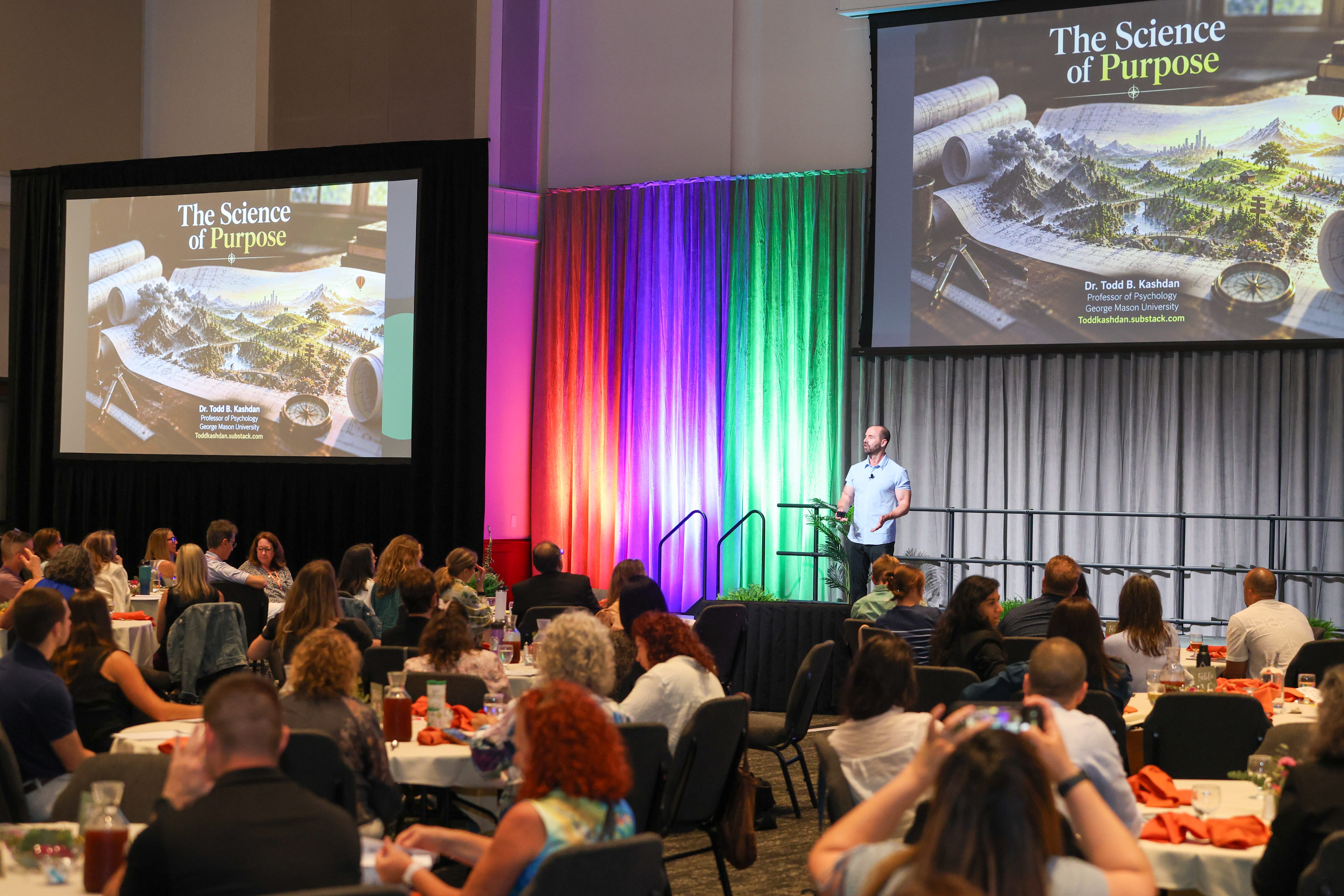
I just flew home from San Diego where I spent a few days at The Health and Well-Being Coaching Conference 2026 giving a keynote on The Science of Purpose and a workshop on How To Make Groups Smarter and Wiser. Unlike many conferences, this is one where the culture is so nourishing, the food is so spectacular, and the views in San Diego are so tranquil, that I might have made friends for life.
The idea I pushed is one that has our team butting heads with researchers at Stanford. William Damon and his colleagues define purpose as an intention to accomplish something “at once meaningful to the self and consequential for the world beyond the self.”
We disagree, because we think a person can build a legitimate purpose around their own expanding sense of self (READ OUR APPROACH), something I like to call healthy selfishness. Demanding that every purpose serve humanity turns a psychological construct into a standard for sainthood.
To make the case, I humbly offer a rewrite of one of the great philosophical books on this question, Albert Camus’s The Myth of Sisyphus. It is a fictional story, so no need to offer sympathy, compassion, and the like…
Sisyphus, Laid Off
The morning after I lost my job, I still woke up before the alarm. Apparently my internal clock requires more than termination for a circadian rhythm switch. I lay there calculating how long we could cover the bills while my partner slept beside me. Our three daughters would be awake soon, and by breakfast one would need a ride and another would be furious about wearing haggard hand-me-down clothes again. I was frightened at the prospect of zero money-making opportunities but keep the sense of dread within.
I thought about Sisyphus, condemned to push a boulder uphill and watch it roll back down. I understood the descent. Camus began The Myth of Sisyphus with the line, “There is but one truly serious philosophical problem, and that is suicide.” And there are predictable risk factors that I, now unemployed, can feel rise.

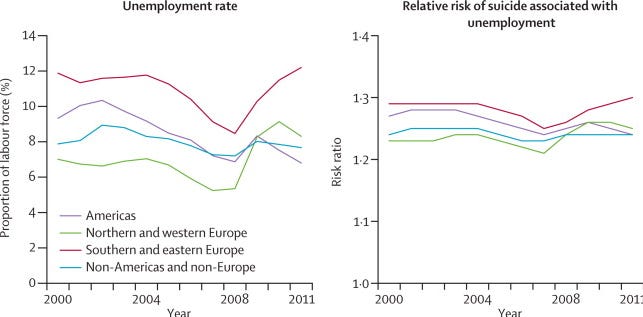
Across 63 countries, roughly one in five suicides is associated with unemployment and the profile fit me, a middle-aged man with a mortgage and no paycheck who followed the social script of responding with “fine” “good” “no worries” if anyone bothered to ask how I’m doing.
I spent 11 years as the guy who answered work calls from the bleachers at my daughters’ soccer and volleyball games, and the boulder rolled back down in a 14-minute video call with an AI creature representing HR who held tight to a script and thanked me for my contributions twice. It was demoralizing. No humans had the ovaries to explain the decision while looking me in the eye.
Camus wanted to know whether life is worth living when the universe offers no ultimate justification for it, and his answer was man finds meaning in the struggle itself. That thesis reads beautifully in a paperback. It has quite a different effect when there is a COBRA notice stuck to the refrigerator saying health insurance for the family ends in five weeks.
I got good at role playing, driving carpool and offering non-Duchenne laughter when my girls introduced wacky tales from their day. My partner offered to pick up extra hours with a hint of accusation (you should be doing more, I did not sign up for this). I wanted to be self-sufficient so badly. It was all I could think about when eating, strolling, lifting weights, or vegging out.
I wanted my life back. I wanted work that paid enough for me to stop comparing five brands of pasta for microscopic discounts in the grocery store. I wanted my daughters in jeans that fit them, that they wanted. Every want was selfish, and together they formed the rope I climbed out on.
My family existed inside that purpose because I loved them, in ways both generous and unabashedly selfish. I liked being the person they could count on, and I missed that version of me. I saw no reason to untangle my motives. I needed to be financially independent for me. For my psychological sanity.
Sisyphus pushes a boulder that accomplishes nothing and delivers him back to the spot he started. Camus concluded that one must imagine Sisyphus happy. On most mornings that season of nothingness, the best I could manage was visualizing myself employed again, and that could sometimes be sufficient motivation to get up before noon. There is no joy. There is a search for meaning and a purpose to get out of this predicament and stay out.
Where do you land? Does a purpose have to reach beyond the self to count?
Know someone who would enjoy this? Forward it. Want new issues? Subscribe, it’s free. And if my writing helps you think, go premium and support the work that goes into this.
Paid subscribers, the full transcript of last week’s wild, fun conversation in our Premium Provoked Community Call is below.
Todd B. Kashdan is the author of several books including The Upside of Your Dark Side (Penguin) and The Art of Insubordination: How to Dissent and Defy Effectively (Avery/Penguin) and Professor of Psychology and Founder of The Well-Being Laboratory at George Mason University.
Read Past Issues Here Including:
Curiosity Questions from Denmark Teens

This is part of a series where I respond to questions by Provoked readers. You can read prior issues here:
I'm not a psychologist, so I don't understand all the nuance, but doesn't this story suggest his "purpose" is bigger than himself? His family? Are kids not a "world beyond the self"?
Good point! As in Camus' The Stranger, we doctors have the privilege of doing something inherently good for humanity, but most are not that fortunate. The need for meaning probably derives from our instinct for survival by human connection and there are many ways to participate in life. At the same time, it is often a vital and not such an easy job to listen to one's insides to find what really resonates. Too many people wind up following inertia or someone else's expectations and lose the deep motivation (and sense of meaning) that has to come from inside.