This is part of a series where I respond to questions by Provoked readers. You can read prior issues here:
The GREATEST data on the importance of selecting the right college
Is Autism Rising? Is it Being Misdiagnosed? Are We Just More Aware?
Below are my answers to questions from six students at a boarding school in Denmark. They are conducting a class project on curiosity and empathy and needed to contact a curiosity expert.
I am not going to print the names of minors just know they impressed me. Here are their questions in order with the answers I emailed to them and some extra content for adult readers.
1. Where does the desire to know more and being curious come from?
There’s that feeling when someone leans close and says they’ve got to tell you something important and while deciding how to phrase it say…nah, I probably shouldn’t reveal this just yet. Dissect that psychological experience and you start to understand curiosity. You were managing beautifully without this information ten seconds ago. Now you crave it.
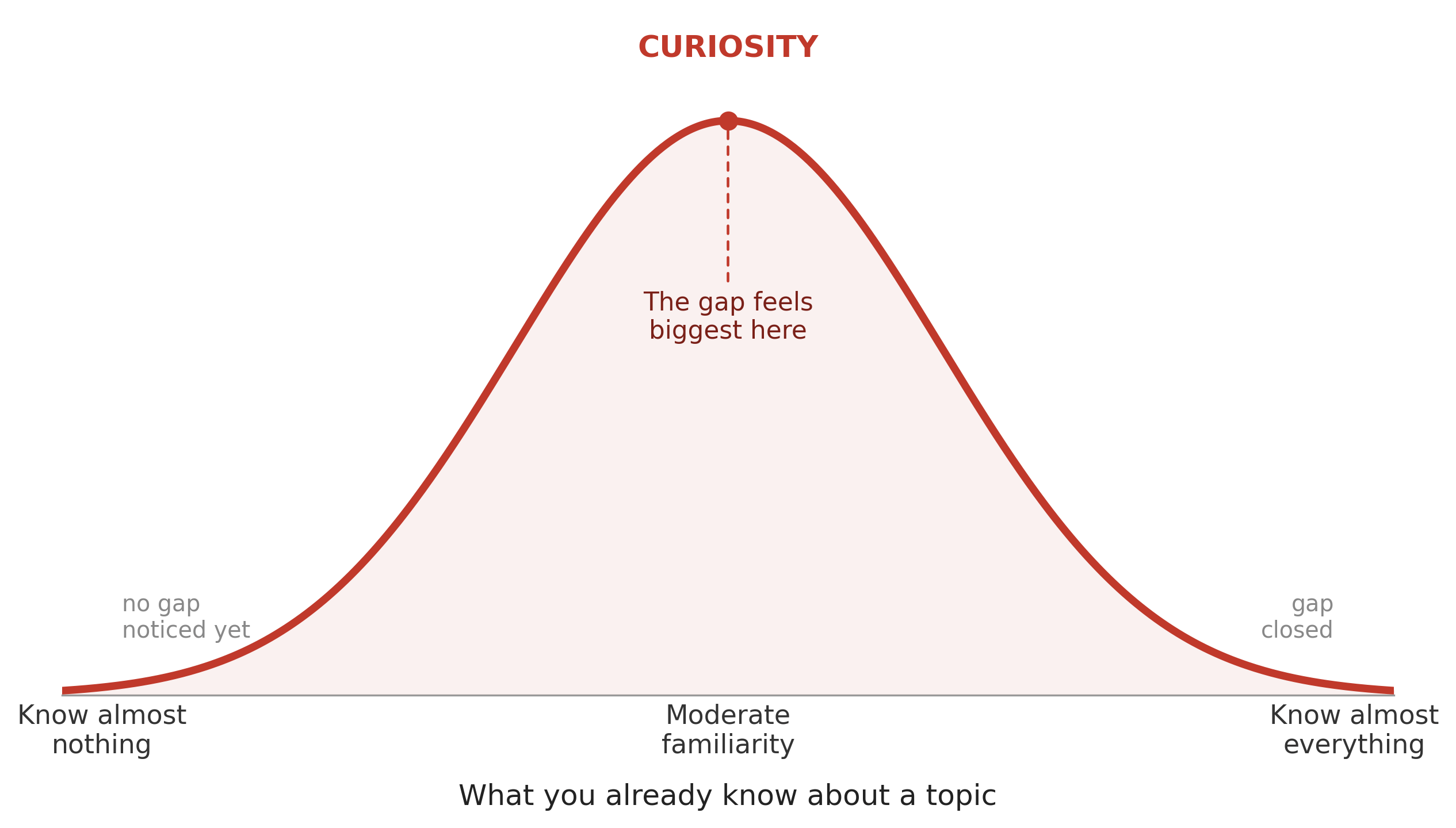
One explanation is that curiosity arises when you notice a gap between what you know and what you want to know. The missing information becomes bothersome. Here’s my image to capture this model:
But curiosity also includes the pleasure of exploring without consideration of any particular stimulation source. You wander through a book fair for the sole reason of being with your partner and wanting to see if anything catches your fancy. You pick up a book about octopuses and discover that a variant near Hawaii - the Hawaiian bobtail squid - that uses light-producing bacteria to camouflage itself against moonlight at night (it changes color to prevent its shadow from being visible!!!). Next thing you know, you are planning an aquarium trip. The desire to discover and the need to resolve uncertainty are both part of curiosity.
In experiments using trivia questions, people spent limited tokens or waited longer to learn answers that made them more curious. Brain scans offered a clue about why an otherwise useless fact could become worth expending effort. Greater curiosity was associated with more activity in parts of the caudate, a brain structure involved in anticipating rewards. Before people saw the answer, their brains were responding to the prospect of finding out. Greater curiosity also predicted better recall of surprising answers one to two weeks later.
For a workshop facilitator or teacher, understanding the mechanics of curiosity offers a reason to spend time on the question being asked before delivering explanations. Give people something to puzzle over. Ask them to generate hypotheses. The rewards of discovering often exceed those who lock in new answers.
2. Is curiosity something we are born with or something you learn as you grow up?
The answer is quick and immediate - both! Notably, the contribution of idiosyncratic experiences is nearly the same as that of genetics. Across experiments with 110 eleven-month-olds, babies were exposed to suspicious physics. An object appeared to pass through a solid barrier. Given the object afterward, the babies banged it against things, as if checking whether it was solid. When an object appeared to hover without support, defying the laws of gravity, they were more inclined to drop it as if it had dangerous juju. Every baby is a tiny scientist without research funding or a cute lab coat, running experiments to find out whether the universe is broken. When the world does something they did not predict, that is when babies explore the hardest and learn the most. Babies need a bit of chaos to expand their knowledge base. Too much stability or too much instability and their brains tend to be inert.
Bonus science: As someone who knows the literature on curiosity I must admit that nobody has conducted a meaningful test of heritability on a high-quality curiosity scale. Our knowledge of the genetics stems from close cousins. Novelty seeking, defined as the tendency toward exploratory activity in pursuit of reward, suggests that 58-61% of the variation in a large twin population is due to genetics. As for sensation seeking, which captures the willingness to take social, physical, and psychological risks to acquire novel experiences, genetics accounts for around 58% of the variation in twin pairs. These percentages describe differences among people in the sample, rather than how much curiosity exists in any one person (Jang et al., 1996).
This degree of genetic influence is typical of human personality as the largest analysis on record, roughly 14.6 million twin pairs across 17,804 traits, puts the average heritability of human characteristics at 49%. So only about a half of why you are more or less curious than another human has a genetic trace. The remainder of the equation is scintillating.
Identifying the particular experiences responsible for boosting curiosity has proved much harder than demonstrating how siblings differ. Still, there is something useful here for adults. You can provide the same opportunities to two children and get wildly different output. Pay attention when one expresses passionate interest. That interest (or lack thereof) suggests a portal to activities congruent with who they are and want to become.
3. Is curiosity the same as having interest or is there a difference?
This question often seems unresolved as scientists continue to publish papers on this topic. If pushed I will say they are related but not identical. Interest is closer to an emotion, the pleasant pull toward something you find new and can begin to make sense of. It is why you might like a song being played or prefer to eat lunch with a particular person from a large group. Curiosity has additional elements that fall outside of interest’s territory such as the uncomfortable need to close a gap, the kind that keeps you up at night because you cannot stand not knowing. Or the desire to acquire information about a potential romantic partner because you want to know whether they’re trustworthy. Or that thrill or sensation seeking dimension mentioned earlier, where you are willing to take risks to seek something new and exciting. Curiosity is a sophisticated motivational system and psychological strength, far more than feeling interested.
Bonus science: Interest is described as a knowledge emotion in a family that includes confusion and surprise. Interesting and pleasant are separable. People rate disturbing images as intensely interesting and intensely unpleasant at the same time. Curiosity can then be split into an appetite revolving around the pleasure of learning, and the craving to erase the discomfort of not knowing. The well-being/wellness industry tends to limit the discussion to the first one as if other curiosity dimensions do not exist. Consider only the pleasant variant of curiosity and you will fail to extract many of the downstream benefits in a consistent manner over your lifetime.