
In my abnormal psychology and Science of Well-Being classes at George Mason University, I asked students to put alcohol, marijuana, and smartphones in front of an imaginary product safety board. The board had access to the existing body of scientific evidence available today.
Would you approve them?
Alcohol comes with a file of cancer studies. Marijuana needs to specify how much THC it plans to deliver. Your smartphone wants to persuade your child to push aside their teddy bear and lie next to them in bed.
Take a vote before reading further. If you could make one disappear, which would it be? For this round, assume it vanishes without a black market or a replacement arriving next Tuesday. Smartphones disappear; ordinary calls and computers survive. Medical uses of alcohol and cannabis stay. You are choosing among recreational drinking, recreational cannabis, and the portable internet.
I want your first answer on the record. You may become remarkably flexible about evidence when we reach the thing you enjoy.
The alcohol hearing
Alcohol causes at least seven types of cancer. The Surgeon General’s advisory attributes roughly 100,000 cancer cases and 20,000 cancer deaths annually in the United States to drinking. For some cancers, risk can begin increasing around one drink a day or less (Office of the Surgeon General, 2025).
Then there are the somewhat convenient data of what happens on roads. In 2024, 11,904 people died in crashes involving alcohol-impaired drivers in the United States. Notably, 39% of those killed were someone other than the alcohol impaired driver (NHTSA, 2024 data).
A new recreational drink trying to enter society with that file would require some top-notch lawyers with exceptional rhetoric skills.
Now you cannot ignore the pleasure of drinking, as this is part of the discussion of both benefits and costs. Also, there is the social lubricant qualities where people loosen up and can be a better version of themselves (at least, after the first bit of consumption). A safety board that refuses to count pleasure has ignored the reality that some of the greatest moments have some semblance of risk. The pressing question is how much harm will you accept for access to the substance, especially collateral damage on people with no interest in touching it.
The marijuana hearing
Referring it as a natural/organic plant does not settle the safety question. Hemlock has roots, too.
The CDC estimates that about 3 in 10 cannabis users would meet the diagnostic criteria for cannabis use disorder. Risk is higher among people who begin young or use it frequently. Potency cannot be ignored because today’s plant is not what your older cousin remembers. If she smoked what everyone else was using, the THC hovered at 5.34% in 2000, and a study of products advertised by dispensaries in three states found an average THC concentration of 22% today. That figure describes those products, not every joint in America. High-potency cannabis concentrates, commonly heated and inhaled through beloved vapes by teenagers and suburban dads, can deliver much higher doses (CDC, 2024).
But putting cannabis and alcohol in the same danger category would be lazy. A British expert panel evaluated 20 drugs across 16 harm criteria, including harm to other people.
Alcohol scored 72
Cannabis scored 20.
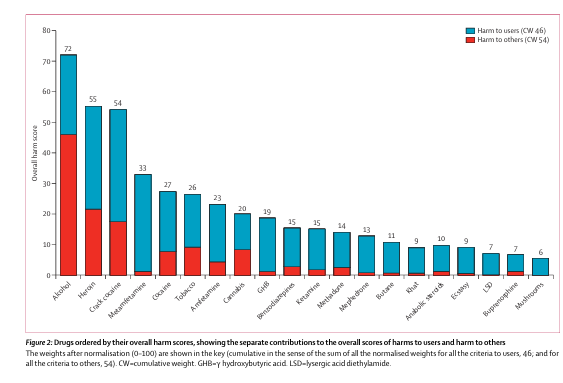
That said, these are weighted judgments about harm in a particular society, published in 2010. They are not percentages, an individual risk calculator, or a verdict on every product sold today (Nutt et al., 2010).
That comparison should be a conundrum for anyone who treats a single old fashioned while reading Circe (my ode -HERE) as a civilized treat and a joint as evidence of reefer madness. It should also disturb anyone who thinks being less harmful than alcohol is an especially ambitious safety standard.
The board still requires a discussion of age, dose, and the conditions of sale. Too often we leave out the specific details that influence the ratio of harm to reward.
The never-ending smartphone hearing
The smartphone has a better case than the prior two. It can get you home when you are lost in the backwoods of Cumberland, Maryland. It lets a deaf person communicate through text. It can help summon a distant friend into a hospital room where you feel nearly naked and afraid. Those benefits must count, even when the same device delivers an unsolicited stranger’s dark opinion of your thighs.
Lumping all of this into screen time makes the hearing almost useless. A video call with my twin daughters in college and an hour refreshing arguments over A.I.T.A. (LINK) are wildly different things on the same pocket sized rectangle.
In a randomized experiment involving 467 people, blocking mobile internet for two weeks improved well-being, mental health, and performance on a sustained-attention task. Participants could still call and text, and use the internet on other devices. Only 119 met the study’s compliance threshold. That limits how confidently results are relevant to people who would never volunteer for such an experiment (Castelo et al., 2025).
A separate meta-analysis of ten studies involving 4,674 participants found no significant average improvement in positive emotion, negative emotion, or life satisfaction from temporarily abstaining from social media. The interventions and methods varied (Lemahieu et al., 2025). And then there is a new study challenging the “smartphones made them do it” hypothesis. As the title puts it: “Adolescents’ daily affect predicts their mobile phone use (not the other way around).” The study used objective tracking data for phone use over 90 days. To the surprise of ardent smartphone haters, phone use did not predict reliable changes in either mental health or sleep. However, feeling somewhat depressed in the morning did lead to more passive smartphone use during the day. Small sample size though, so if you want to use motivated reasoning to kill this study, this is your angle...
None of these studies offer a confident answer on whether to abolish smartphones nor establishes what a phone ban will do for a particular child (interestingly, everyone ignores adults who are even more physically attached to their phones). A sensible board would inspect the features and conditions of use. It would ask harder questions about an endless feed permeating a walk home from school than a map on a hiking trail.
I would keep the map. I would make the eternal scrolling feed reapply when they uncover a way for users to have more agency about whether something comes next or not on the screen.
Your drug of choice gets a hearing, too
If the admission standard is zero harm, it will eventually confiscate your bicycle and your smartTV. The case for restricting something also has to deal with questions about freedom, benefits, and what enforcement on these targets leads officers of the law to then ignore (in my worldview, kidnapping cases should get priority). Outside this thought experiment, banning a product does not make demand disappear.
I am willing to defend targeted restrictions. As a well-being scientist, I want consideration of well-being dimensions that are elevated, even a bit. Sometimes a person wants a beer because they are highly attuned to sensory pleasures. Fine. Put that benefit beside the costs and argue with greater contemplation of other perspectives.
What interests me is the exemptions that people want. Perhaps your drinking counts as an appreciation of craft (like my friend Dan’s awesome sauce Small Batch Brewing beer truck - HERE). Your cannabis use might want to be acknowledged as reliable tranquility in the vein of yoga classes and saunas. Adults love to use a get-out-of-jail free card by claiming to youth that theirs counts as staying informed, even if that means investigating a neighbor’s impending divorce on social media for….days.
You can investigate these targeted domains without waiting for a legislature. Think of situations where you lack agency and you are passively ingesting and tossing energy away automatically. Ask what you want to happen there. At dinner, do you want to be fully engaged in a conversation? In bed, do you want to sleep?
Give the thing you dislike a competent defense. Each of these areas is complicated, especially the phones.
Paid subscribers: invisible to others, below are additional thoughts that are too premature to reveal publicly.
Know someone who would enjoy this? Forward it. Want it to keep showing up? Subscribe, it’s free. And if my writing helps you think, become a premium subscriber and hand me a burst of joy and meaning.
Todd B. Kashdan is the author of several books including The Upside of Your Dark Side (Penguin) and The Art of Insubordination: How to Dissent and Defy Effectively (Avery/Penguin) and Professor of Psychology and Founder of The Well-Being Laboratory at George Mason University.
Read Past Issues Here Including:
FIRST LOOK - My Curiosity Productive Inefficiency Model

NOTE: this is part of a series on the science of curiosity including how this strength changes over the lifespan (click here for Part I and Part II), benefits memory and creativity (here), alters social interactions (here), persuades people (here), and
One notable difference between the data on alcohol/cannabis vs smartphones is the time horizon of insight. Temporary abstention-based studies don't really yield insight into long-term mental health implications of smartphone use.
For me, alcohol is the one to get rid of. Regardless of any detriment from smart phones, they have more positive utility for society than alcohol.
Recording Alcohol before I read.. That was a fun exercise. I love thinking about well-being within the messiness of the real-world too. Ordinary. Every day. One has to go! It's so deliberate choosing, and then I noticed the softer version of my view - a lot less please everyone! Surely there is some boy math that can be used to declare optimal consumption that enables the children to be cared about, people to be happy enough, so the glass of crisp wine on a sunny afternoon can be enjoyed.